
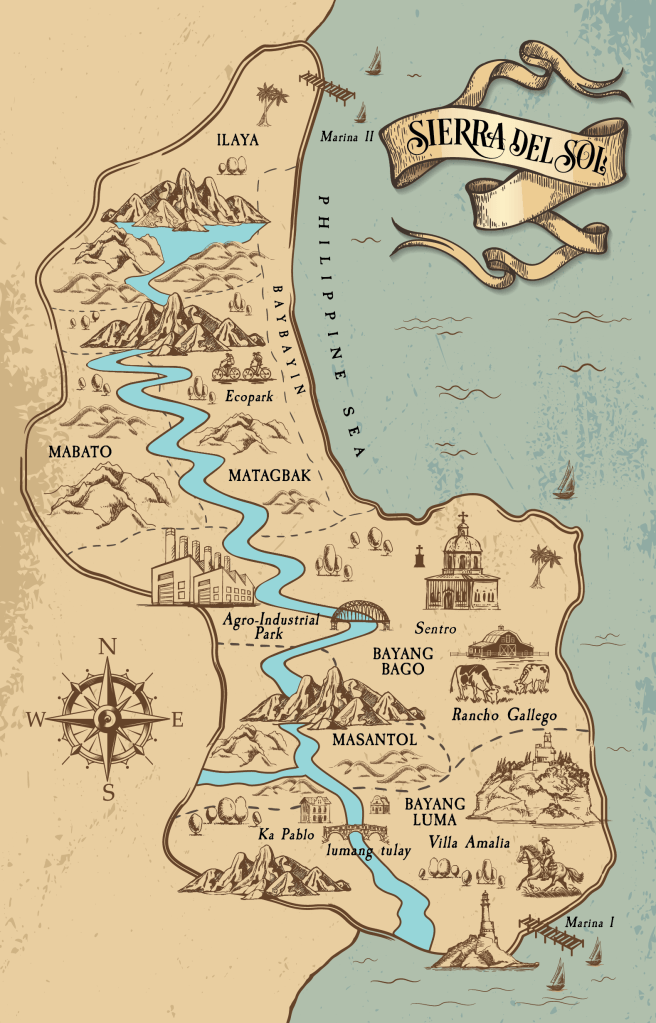
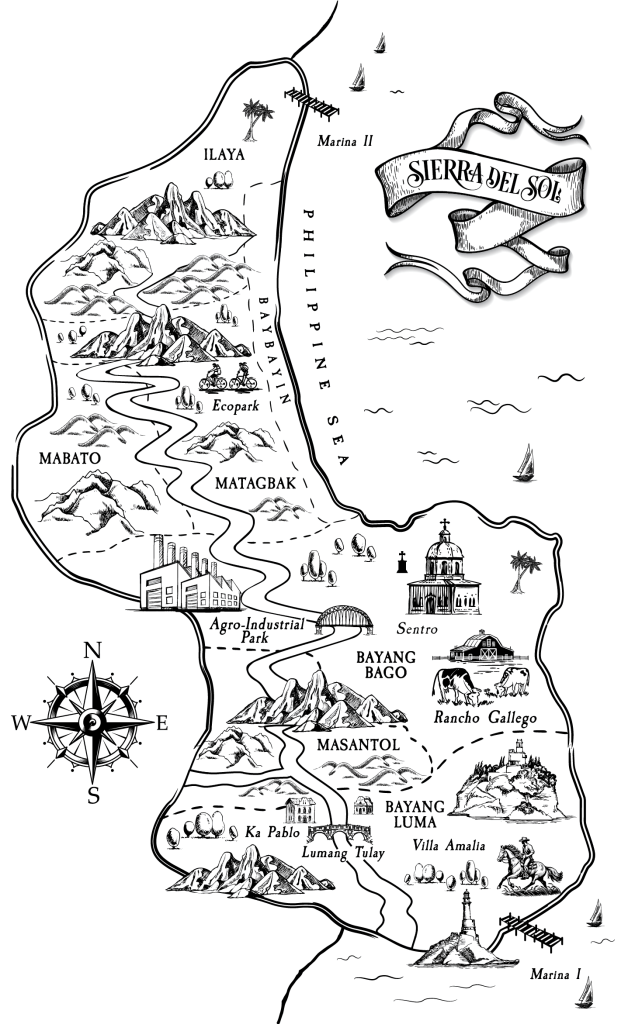
Miraginata Map
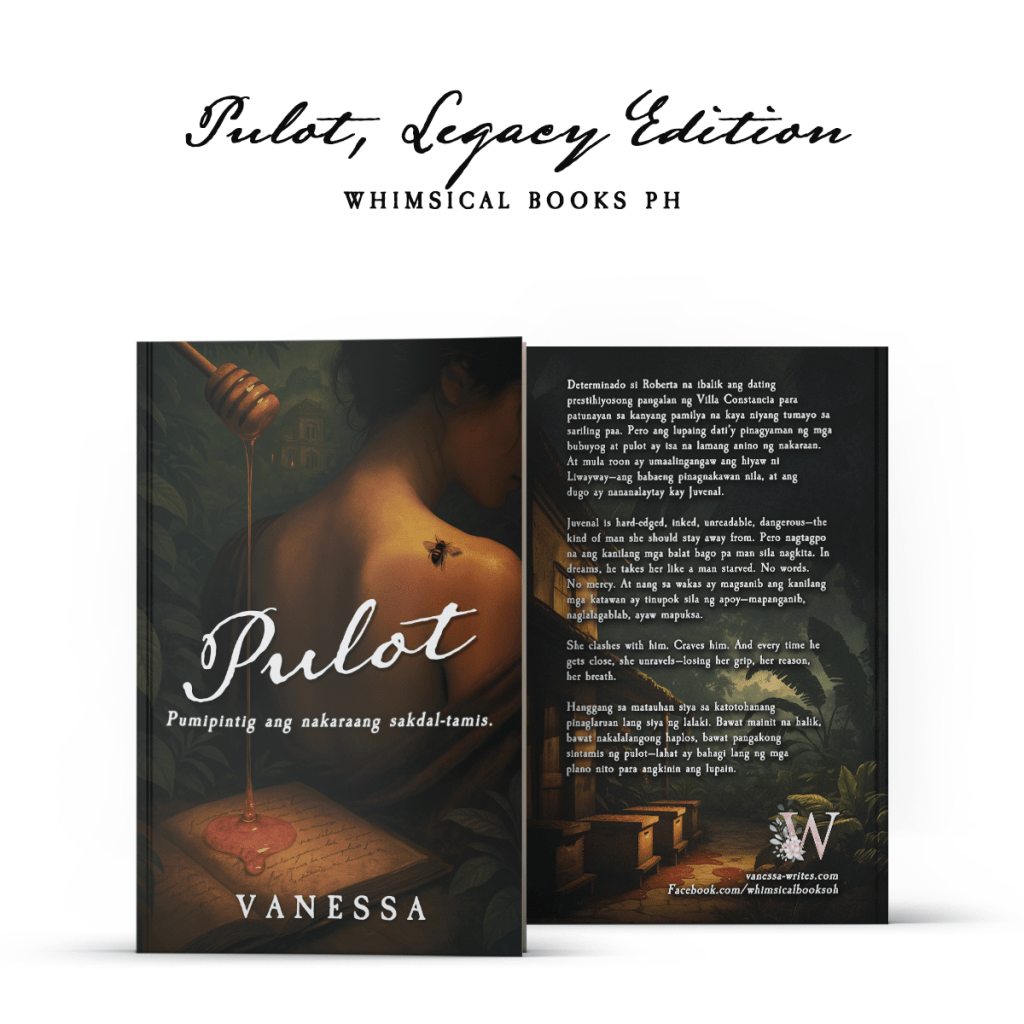
Why Two Covers for Pulot?
The truth is simple: platforms like Facebook and other major social media are increasingly strict about what they allow—even when it comes to art and romance.
Even modest sensuality can get flagged, restricted, or banned.
To make sure Pulot could reach readers without issues, I created two covers:
Both covers are true to Pulot. One plays safer for public platforms. The other stays raw, the way the story first demanded to be told.
About Bare and Undone
Due to strict content policies, the public preview of Bare and Undone—including the version displayed on this website—is censored to meet platform and hosting guidelines.
The full uncensored archive will be provided exclusively to those who avail of the promo.
PULOT
Determinado si Roberta na ibalik ang dating prestihiyosong pangalan ng Villa Constancia para patunayan sa kanyang pamilya na kaya niyang tumayo sa sariling paa. Pero ang lupaing dati’y pinagyaman ng mga bubuyog at pulot ay isa na lamang anino ng nakaraan. At mula roon ay umaalingangaw ang hiyaw ni Liwayway—ang babaeng pinagnakawan nila, at ang dugo ay nananalaytay kay Juvenal.
Juvenal is hard-edged, inked, unreadable, dangerous—the kind of man she should stay away from. Pero nagtagpo na ang kanilang mga balat bago pa man sila nagkita. In dreams, he takes her like a man starved. No words. No mercy. At nang sa wakas ay magsanib ang kanilang mga katawan ay tinupok sila ng apoy—mapanganib, naglalagablab, ayaw mapuksa.
She clashes with him. Craves him. And every time he gets close, she unravels—losing her grip, her reason, her breath. Hanggang sa matauhan siya sa katotohanang pinaglaruan lang siya ng lalaki. Bawat mainit na halik, bawat nakalalangong haplos, bawat pangakong sintamis ng pulot—lahat ay bahagi lang ng mga plano nito para angkinin ang lupain.



Unedited, pardon grammar errors
___________________________
Even now, as I type this, I feel sad remembering how little time I gave this trip. If one has time, one should consider spending at least three months in Morocco. Even three months wouldn’t be enough to explore this wonderful country and its equally wonderful people and culture.
Fes for me has more charm than Marrakesh. It is the oldest city in Morocco with the most number of streets at 19,000! We woke up relaxed, had our breakfast, and prepared for the tour we scheduled the day before. It was a walking tour and started at ten in the morning (you can choose the time most convenient for you). The price of the tour was 250 dirhams (P1,200.00 or 24 euros).
Our guide was an old gentleman who grew up in Fes. He had a rather solemn demeanor. I personally felt like a student, and he my professor. The tour started with a word of caution from him. We were told to keep all belongings secured at all times and not to talk to strangers.
Our first stop was Bou Inania Madrasa. The entrance fee was 10 dirhams (P50 or 1 euro). It’s a stone’s throw away from our hotel, along one of the two main streets of Fes.
Doors. Morocco and doors. Immediately, I noticed how different Moroccan doors were. They are mostly made from real hard wood, wide, colorful, and embellished with metals. Our guide said that doors used to be a status symbol. The bigger and more luxurious your door is, the richer you are. That explained a lot of things to me.
The doors of Bou Inania Madrasa were huge but unassuming. When you enter it, you will see a peaceful and clean sanctuary of scholars for centuries. It was founded AD 1351 to 56. Can you believe that? It’s still standing, and well-maintained. IT’S IN THE MIDDLE OF A BUSY MEDINA! It’s very peaceful inside, even if there were tourists taking photos. We spent about a half hour here, the guide explaining how every single geometric pattern we see has a number that goes on and on, symbolizing infinity.
We continued on with the tour. The medina was a feast for the senses, all different aromas and sights. Bread was made the traditional way. Stalls have big round stones to make crepes. It was fascinating for me to see an oval shaped stone used to make very thin layers of bread.
The mountains of nuts and spices were also everywhere, as well as stalls selling torones/nougat. I’ve never seen so many that at first glance I thought they were huge bars of soap a la Lush. Leather goods are also much cheaper in Fes compared to Marrakesh. But buyers, please remember that the stink from the leather doesn’t come off easy. You might find a wonderful leather purse that would sell four times more where you’re from but the one you will find in Morocco will have to be aired out, drenched in baking soda, wrapped in paper, swabbed with vinegar, and all that. The bigger the bag, the heavier the stink you need to battle with. So remember this when buying Moroccan leather goods. And yes, if left outside a plastic bag, it will stink up your whole house. You see, they use natural dyes and natural leather softener, which is pigeon poop. I asked the guy from one of the biggest tanneries, “Do you ever run out of pigeon poop?” He said they actually have pigeon poop suppliers. I wanted to ask more about it, like how the supplier gets the merchandise but I don’t think he was interested in such shitty conversation.
After all that leather, we went to see where they make fabric from the agave tree. I purchased a scarf (I always do this yet, I don’t know why. I don’t even like scarfs all that much). We then went to an old-fashioned apothecary shop selling a wide array of perfumes, oils, kohl, herbs and herbal medicines, and even masala. I bought kohl eyeliner, masala, saffron, and got my mother a small bottle of myrrh, which the apothecary called “Jesus oil.”
We continued walking through narrow streets, some too narrow to pass through. A few times, I wondered how I’d be able to struggle if buried under the rubble of the entire city if an earthquake suddenly hits. I can be morbid that way. We went to a place where people dyed fabric, and onto a place where copper pots and pans were made and sold. There were old-fashioned blacksmith shops, and stalls that sold hand-carved wooden ornaments. I wanted to buy everything but alas, I doubt I can bring them all home. Up until this day, I regret not buying at least one copper pot for candy making. Maybe next time. Because I will go back.
The tour ended early. My feet were killing me. The rest of the day was spent in the hotel. Elton almost never speaks but boy was he a riot, counting every section of the patterns we saw, like our guide did. We probably didn’t stop laughing for hours. Fun times. We talked about history as some of the Moroccan marble we saw came from Italy, in exchange for sugar back in the day.
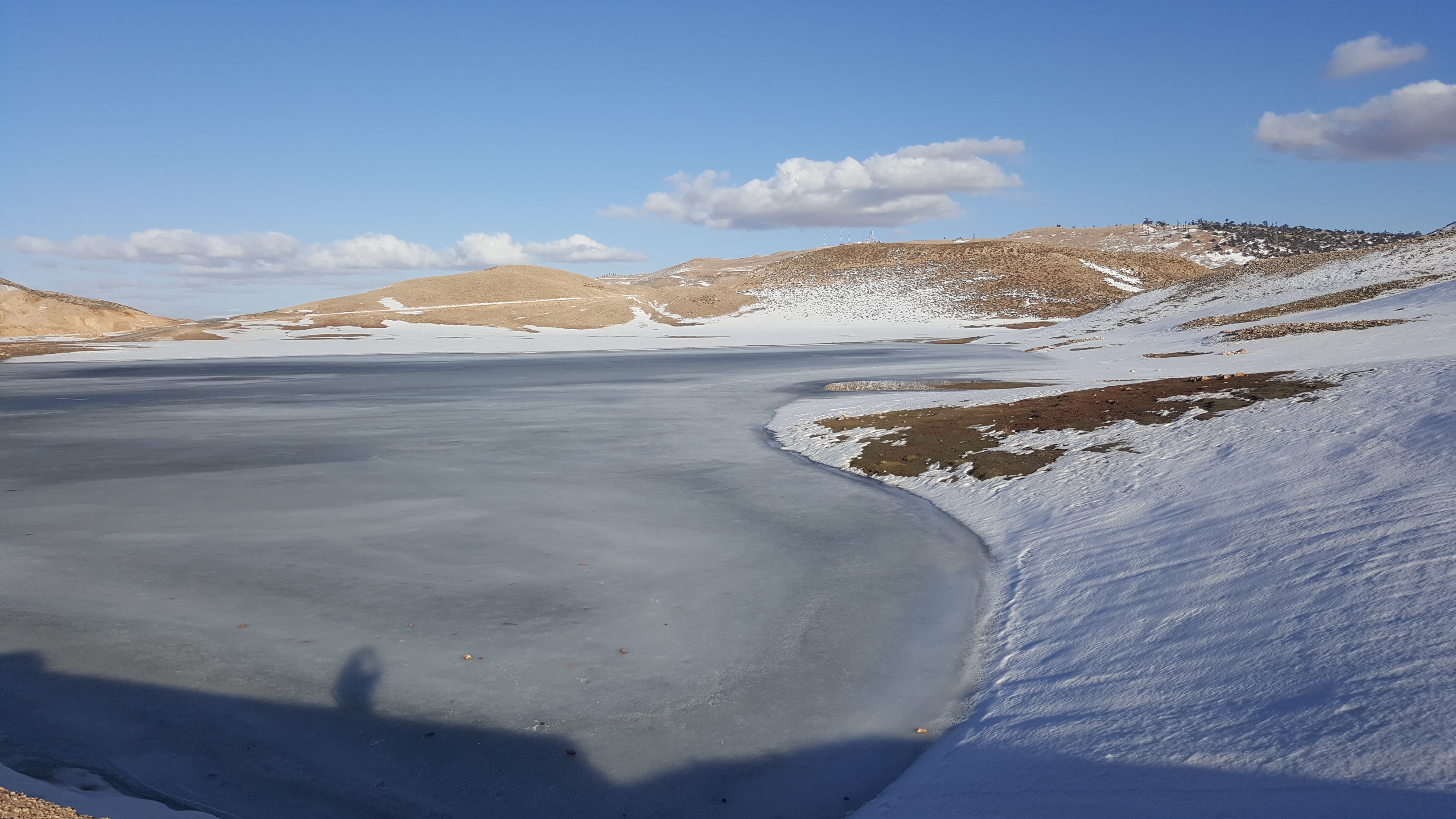
We had dinner, rice and kebabs, oranges and bananas for dessert. We hit the sack and started the next day early. We headed to Volubilis, a UNESCO heritage site an hour and a half away from Fes. One can see it from afar. Elton commented it’s obviously Roman as Romans chose mostly places like it—near water supply, cool climate, the works. We paid the entrance fee of 20 dirhams (P107/2 euro). What can I say? The place will give you perfect photos. The remnants of Roman civilization is very interesting, and the view is simply stunning. From here, you can see Moulay Idriss, a town on the hills at the base of a mountain. We drove and saw it as well.
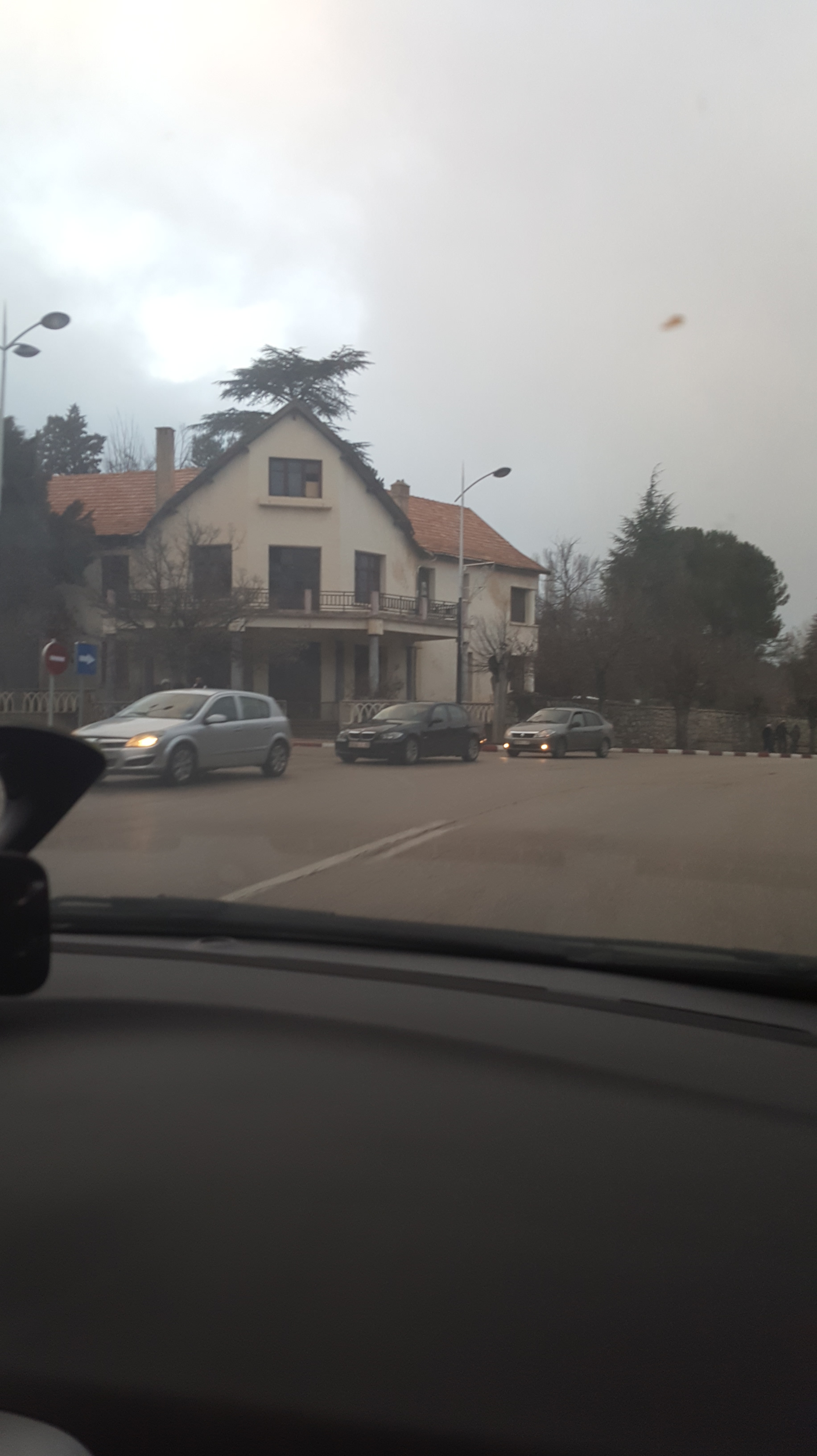
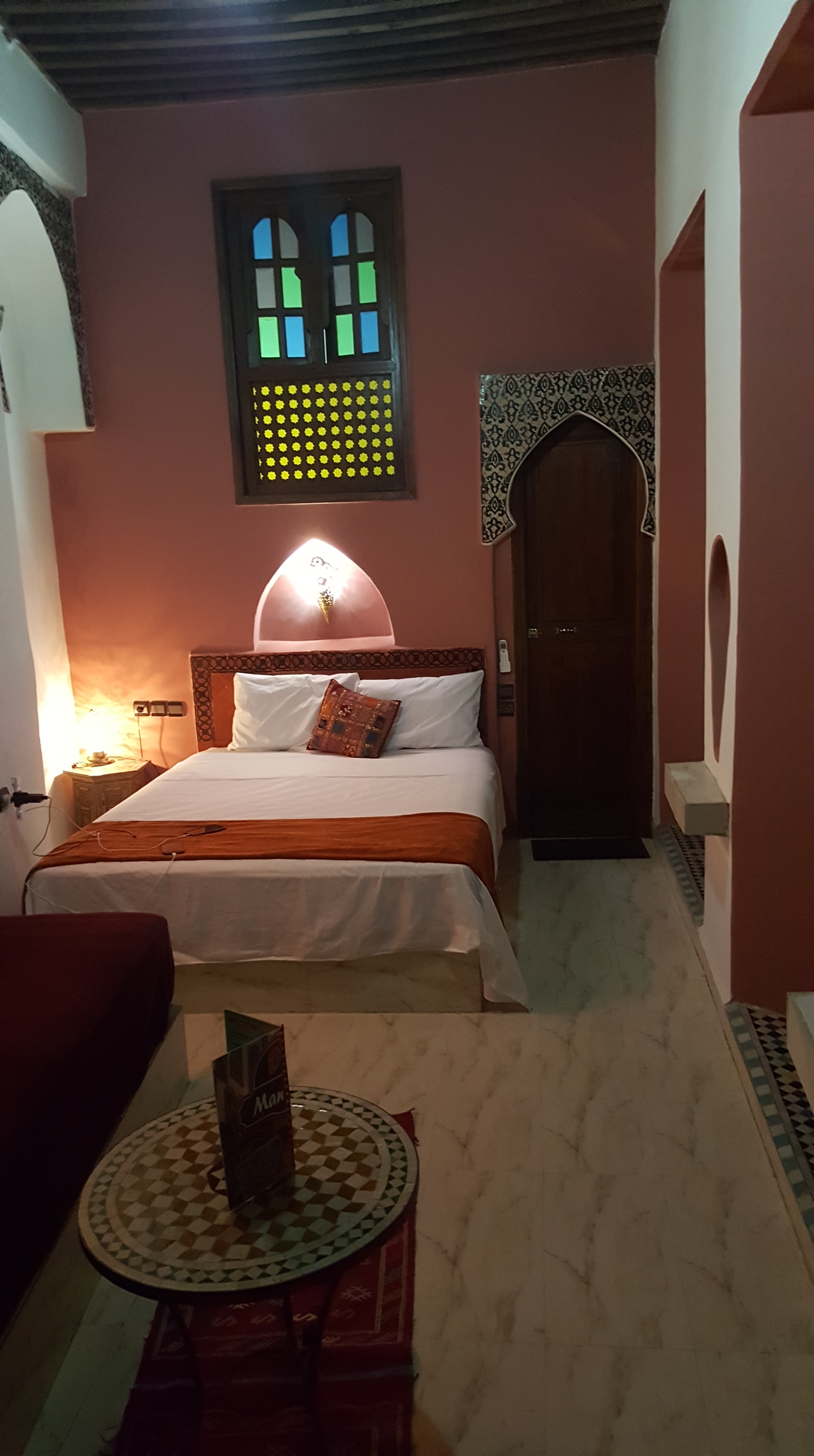

We headed back to Fes, had lunch along the way, and shopped for souvenirs. I bought a couple more of leather items and plates, Elton shyly asked me to haggle for him, and the night ended with me feeling sad because we will be heading to the city the next day and the day after, we leave.

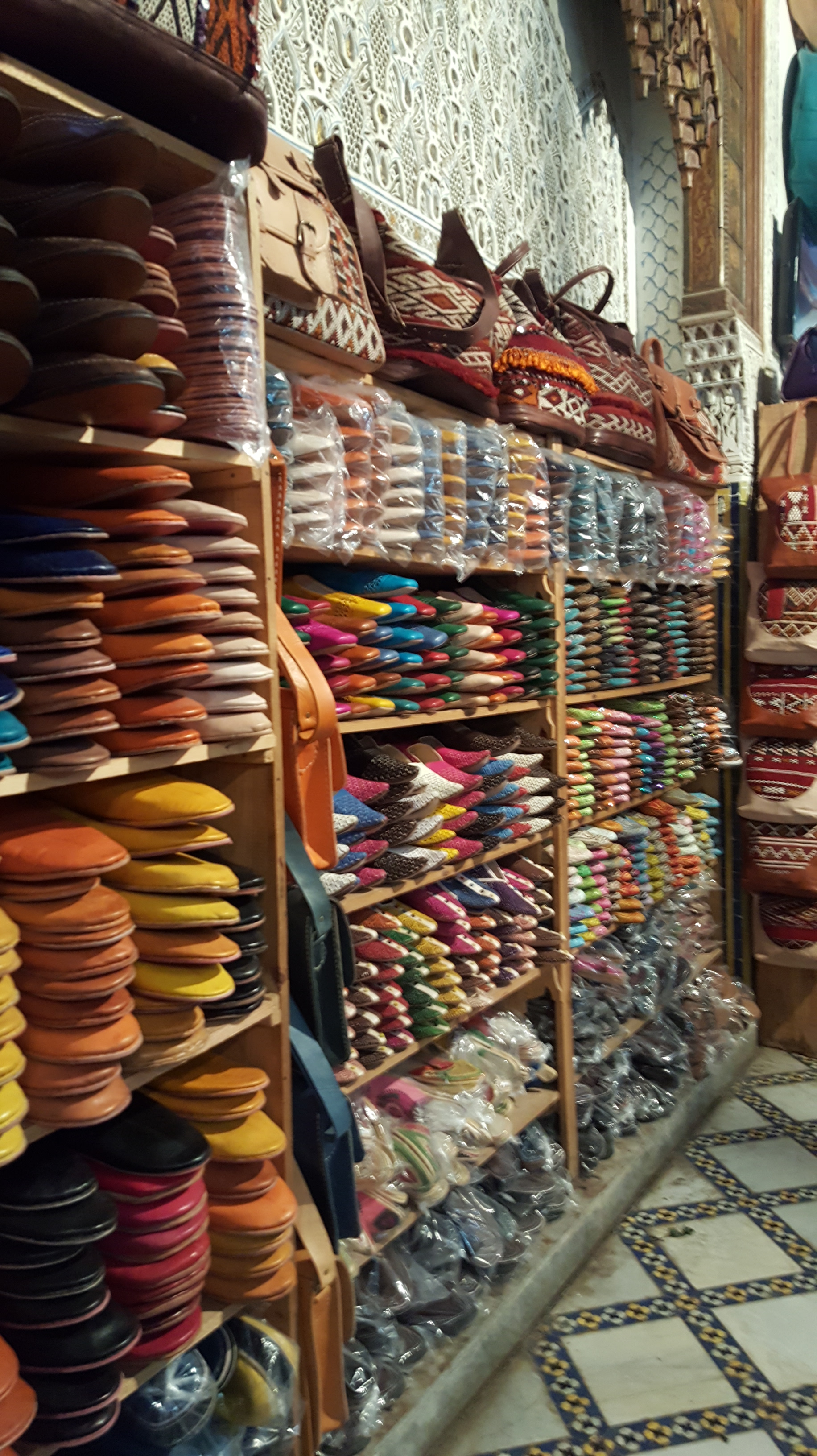
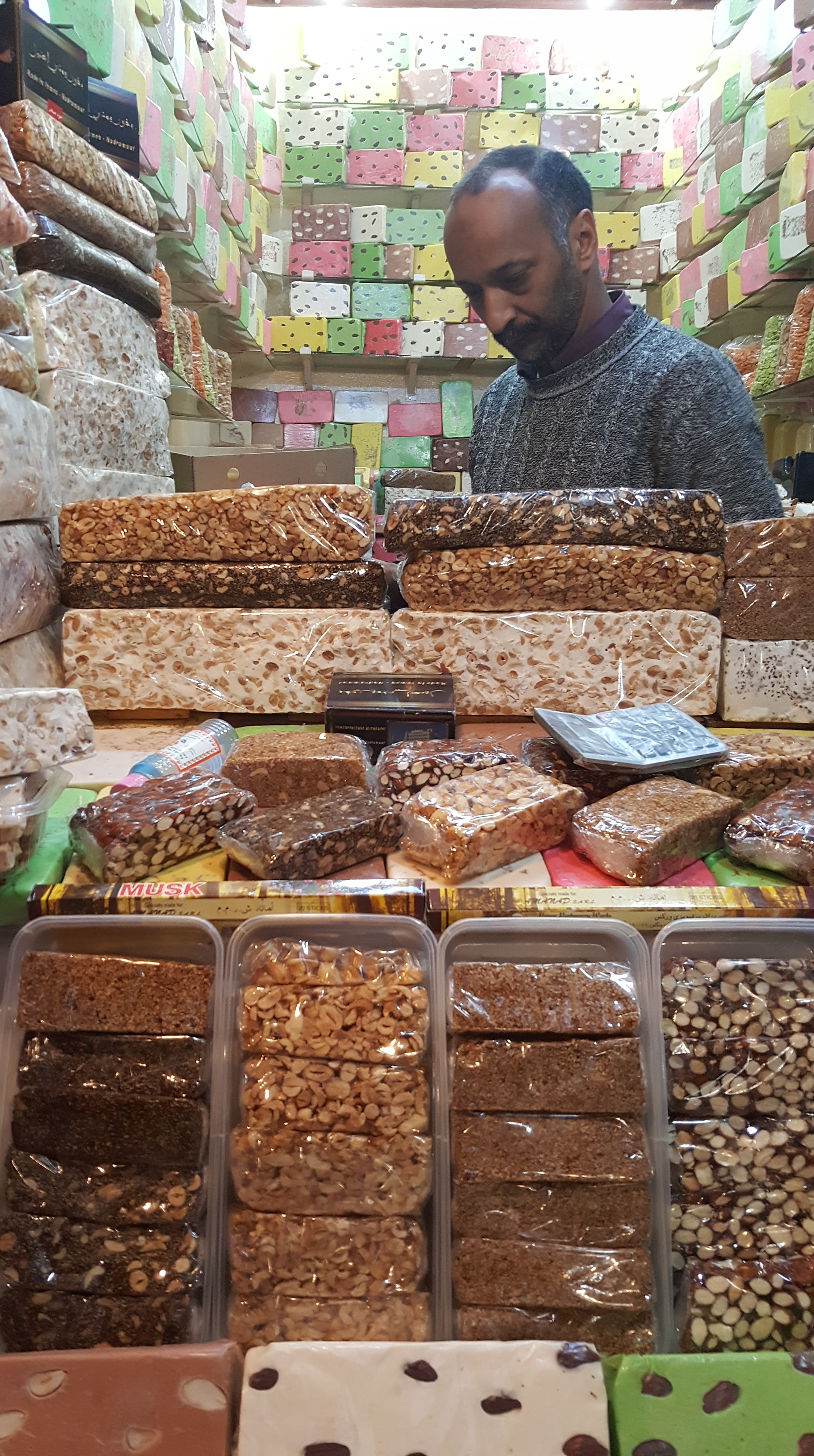

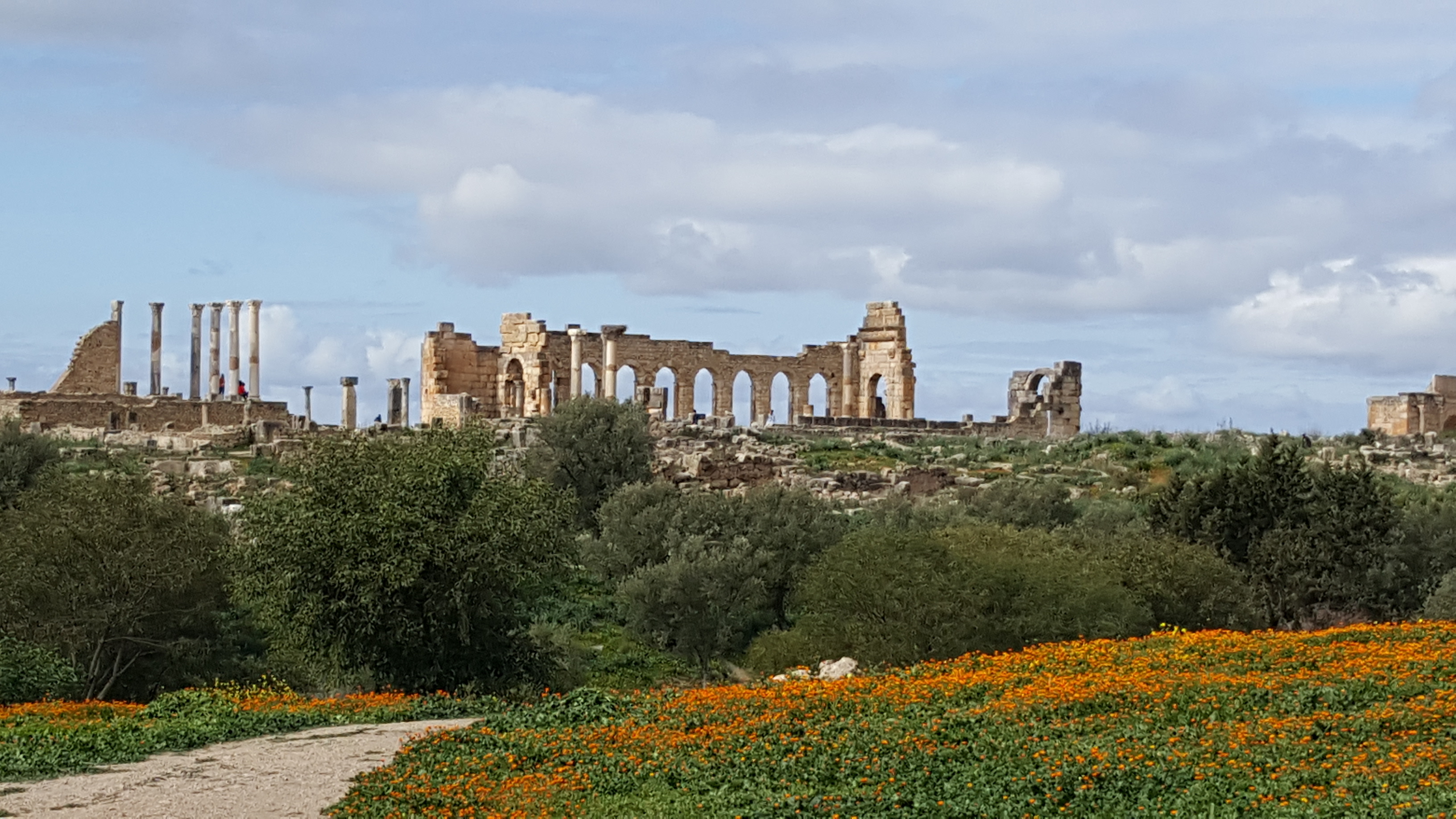
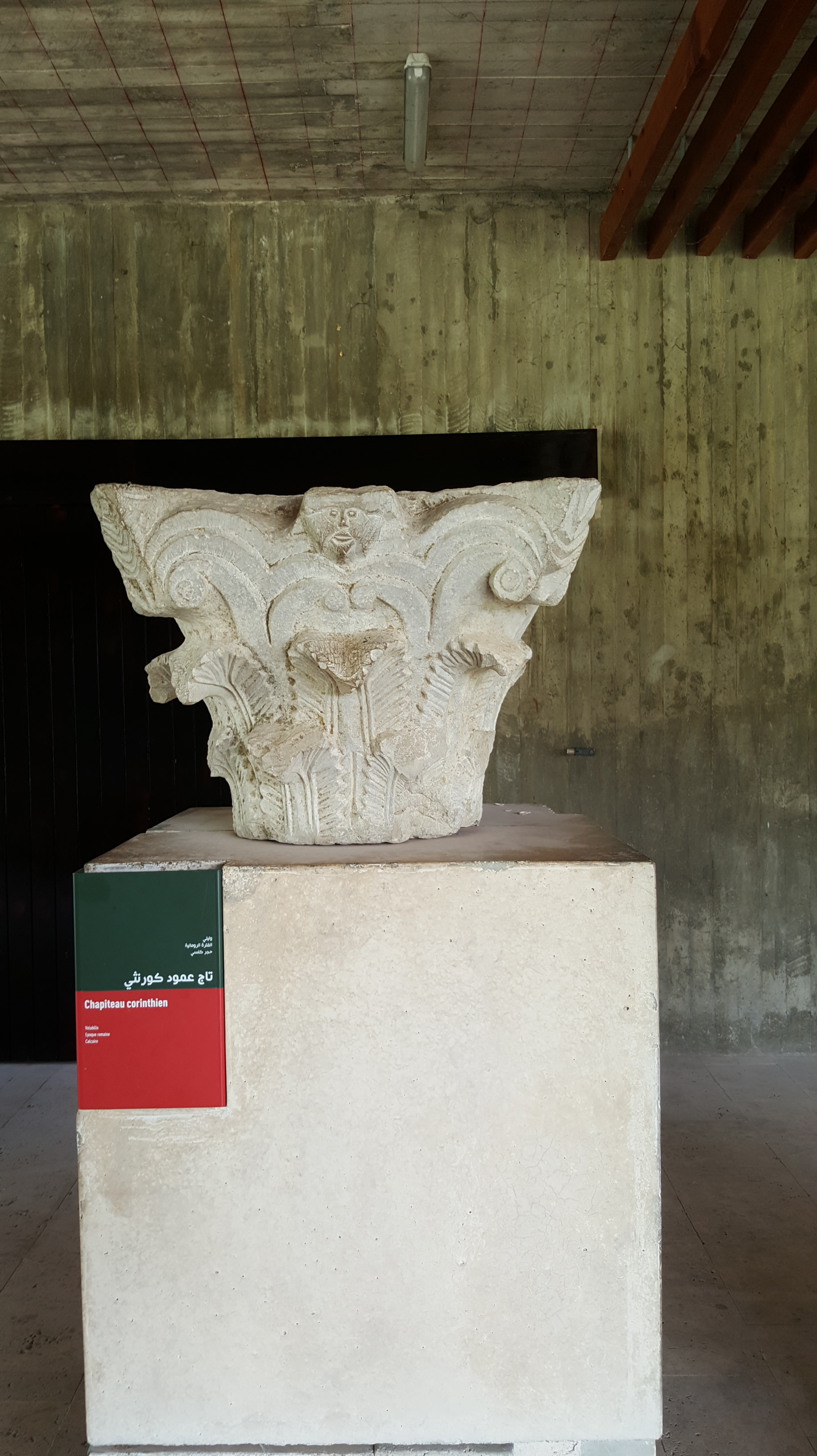
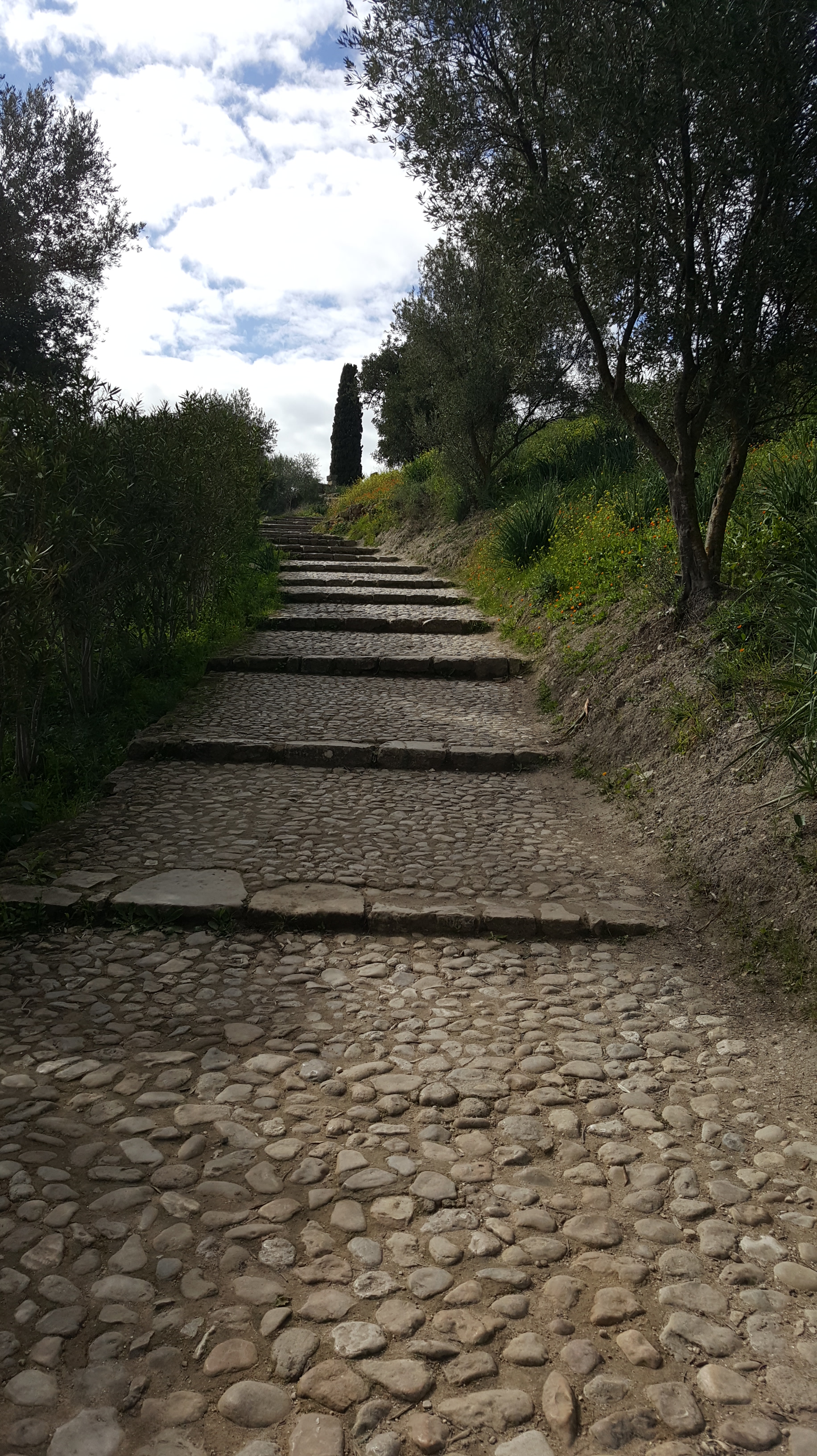
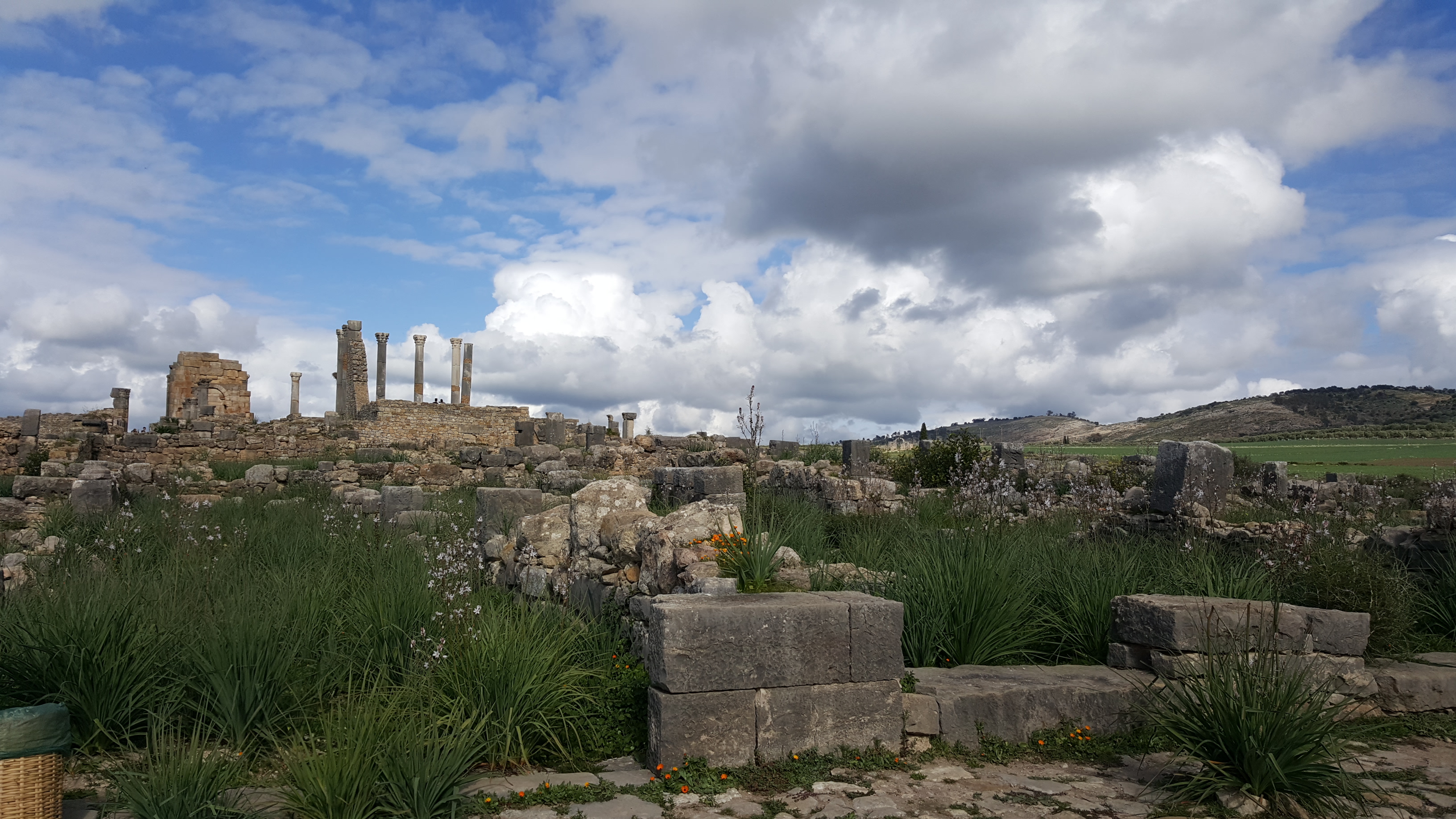
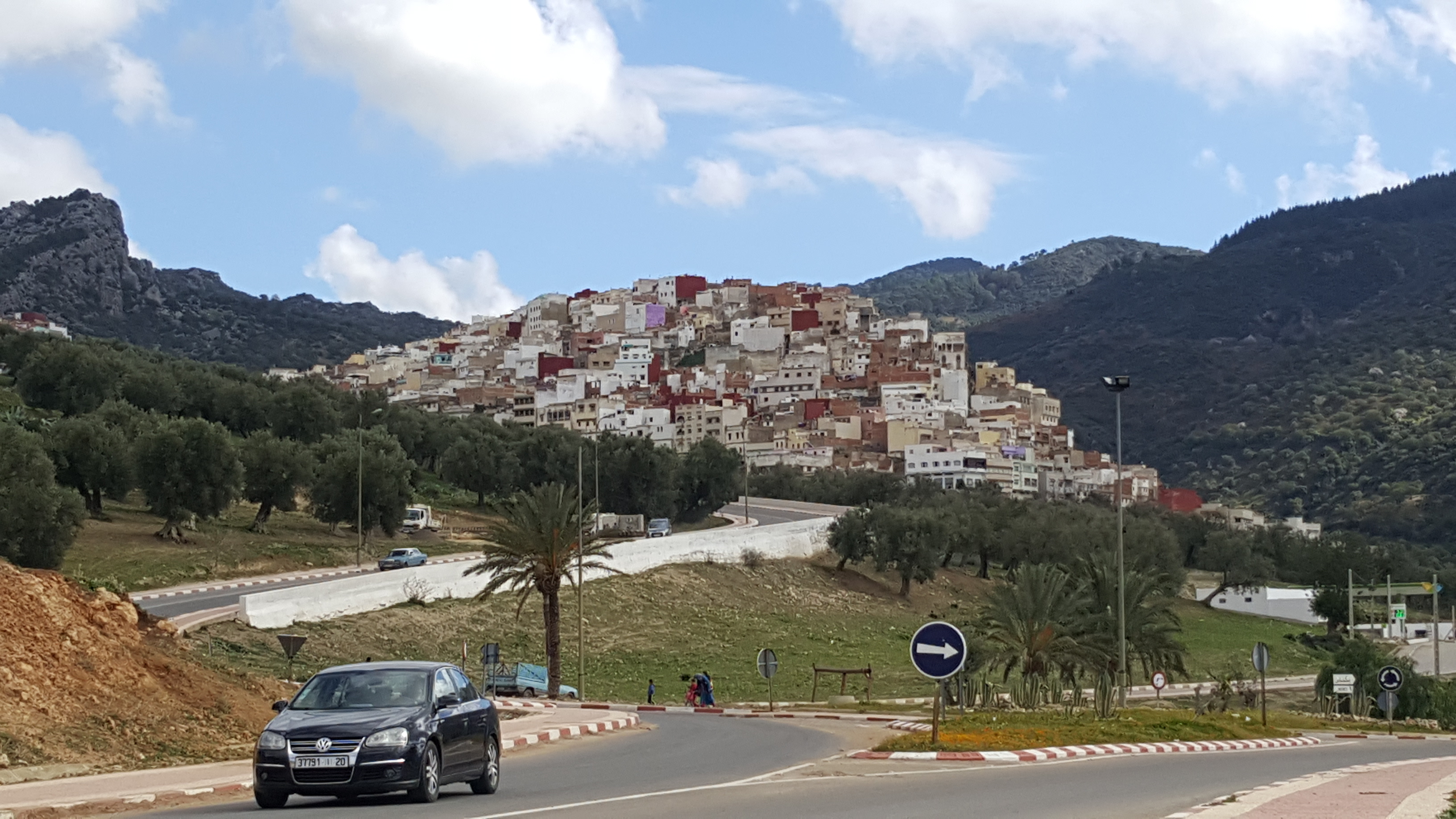
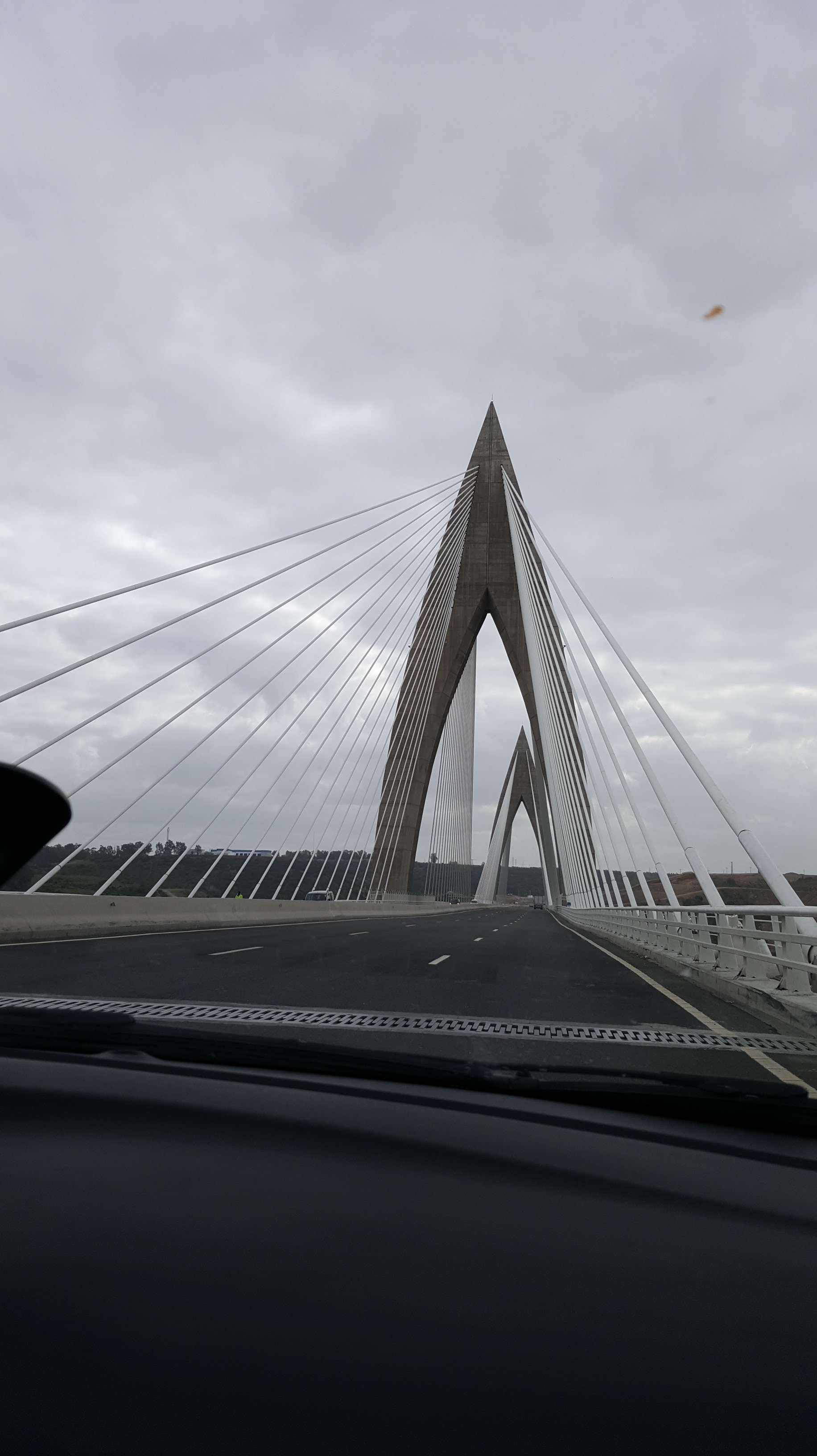
The next morning, we started early for Casablanca. It was going to be a long drive at 256 kilometers. The route was, as always, scenic. The ride in itself was fun, but I still couldn’t make myself feel happy as we were gonna end the trip in just a few hours.
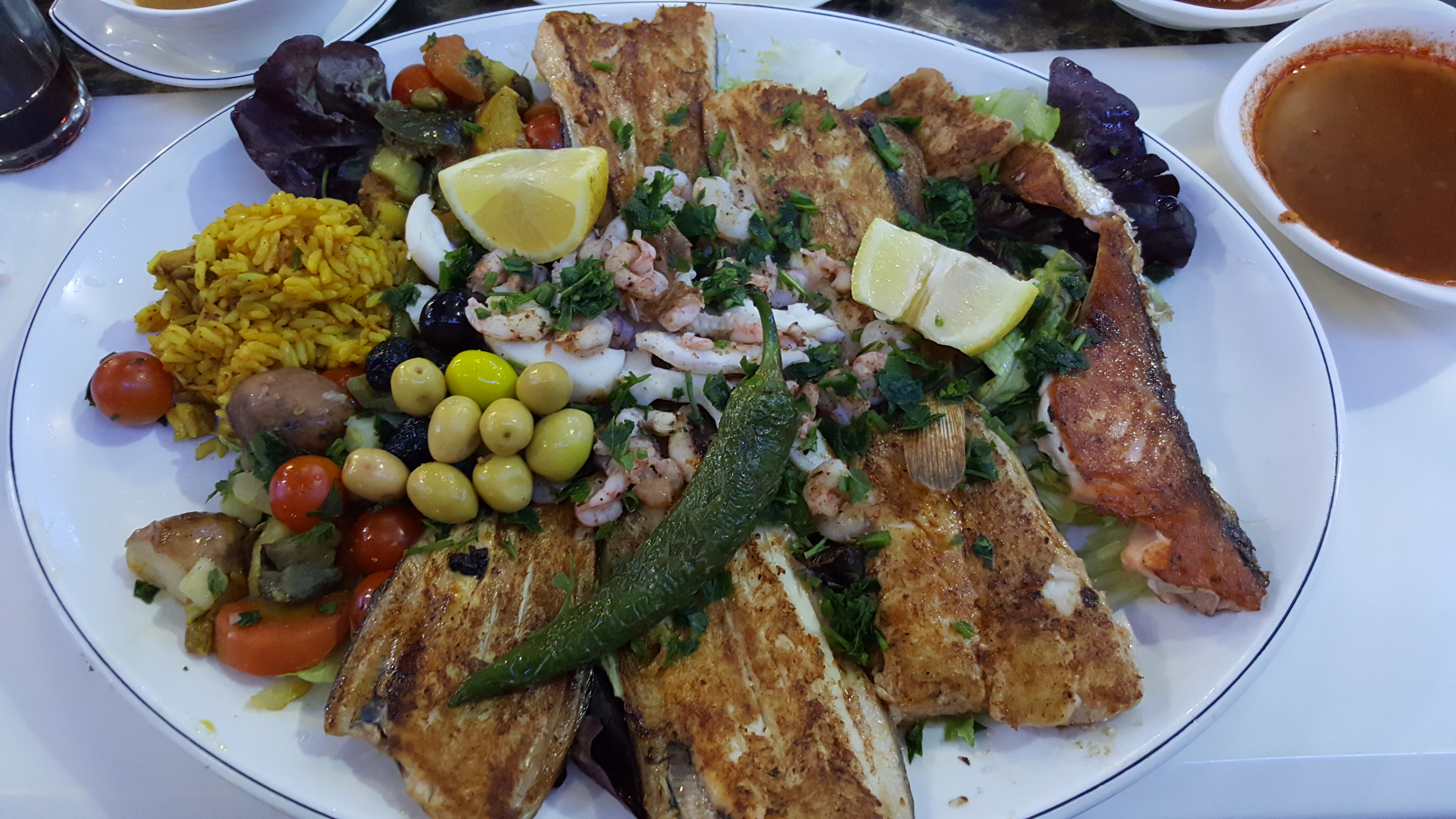
We reached Casablanca before nightfall. The hotel was quite nice, the rooms very spacious. I decided that we should have a seafood dinner since Elton loves it. We went to a restaurant named Snack Amine. The serving was huge! We weren’t able to finish our plates. As Elton was eating, I took out my phone and took a video of him. I swear I have never seen anyone eat as classy.
We headed back to the hotel afterwards. I started organizing my stuff. And this is where I’ll stop writing about Morocco because the flight back home was uneventful and left me feeling even emptier. I actually cried at the airport.
In conclusion, yes, a trip to Morocco from the Philippines will NOT be cheap (at least not as cheap as traveling to ASEAN countries) but about half of the price you’ll be spending will be for the flight. Is it going to be worth it? YES. ABSOLUTELY. I will do it again! Morocco is very underrated. Go, see it. It’s breathtaking.
How I feel about the rise of the trolls in the Philippines was never a secret. What are trolls anyway? So many definitions are available online but for me, trolls are individuals who go out of their way to cause confusion, anger, and fear by spreading “alternative facts.” There is a fine line between trolls and apologists. They are equally annoying but if a troll is fueled by money or narcissism, apologists are often victims of trolls’ “alternative facts” a.k.a. lies.
What bothers me mostly about trolls is the fact that they influence a lot of people. I lament the death of critical thinking. Reading, exposure to other cultures, and the realization that the world is a big place don’t seem to make any impact in a lot of people’s social and political perspective.
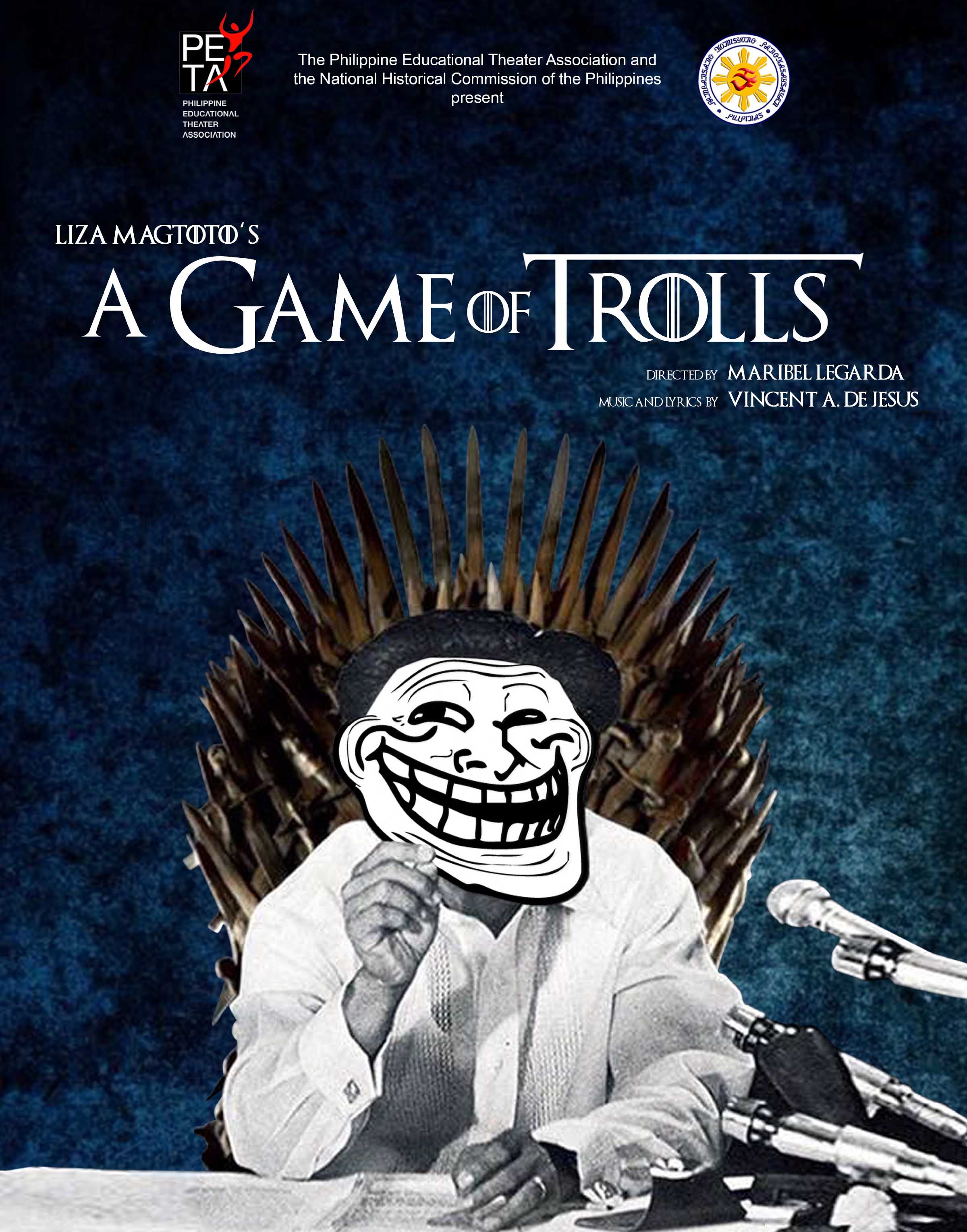
Before seeing the play, I wondered how it can influence the audience. Lately, people have been more than passionate in their political views that it has created a huge divide. Critics are immediately filed under “destabilizer” and therefore must be attacked. I asked myself if the musicale might in some way anger people. How does one deliver a message that would say “accurate” and “fair” without it being preachy and boring? In a time where memes play an important role in disseminating news or propaganda, something like AGoT might prove to be a challenge for PETA.
I should have trusted PETA more. AGoT is a well-researched musicale that tackles facts that have been a subject of heated debates for years. It is very Filipino in delivery, has sense of humor, and tugs at one’s heartstrings as our recent history should.

AGoT is a story of Heck, who works in a pro-Martial Law troll center run by a man named Bimbam, an Apo loyalist. Hector’s estranged mother, a former Martial Law activist, comes for a visit and tries to work on their relationship. But years of alienation have turned a son’s heart cold and made him apathetic.
Hec finds himself being haunted by ghosts from the Martial Law regime, who all tell him their story. He tries to fight these truths, argue that they deserved what happened to them… Until his mother reveals her own tale that still torments her decades later.
The musicale was written by Liza Magtoto and directed by Maribel Legarda, producers of the PETA hit “Rak of Aegis.” The songs were written by Vincent de Jesus.
“Laos ang Asar-Talo” has lines that can never be more accurate:
“…Pag naglabas ng issue, tirahin niyo ng personal
Pagurin niyo, sumagot nang pabalang
Ibahin niyo ang usapan, hanggang sa mapikon (Dahil laos ang asar-talo)
Lunurin niyo sa kasinungalingan, hanggang sa pati sila ay malito
Kung ano nga ba ang tama? Kung ano nga ba ang ano?.
“….Non sequitur ang ating bala. Kumasa at tumira
(At kung di pa rin umatras, lagyan ng ad hominem pa)
Gumawa ng mga fake accounts gamit ang picture ng iba
Sumagot ng naka-all caps at i-copy paste sa bawat thread
Ng bumabatikos kay Madam.”
The actors delivered well, especially Upeng Galang-Fernandez, who played Nanay Tere, Hector’s mother. It was impossible not to shed a tear or two as she delivered a powerful monologue towards the end of the play.
I highly recommend AGoT to every Filipino, young and old. For ticket and inquiries, you may contact Queng Reyles at 725-6244 loc. 23; 0917-5394707; quengreyles@yahoo.com.
[This post has not been edited nor proofread. Please pardon errors.]
There is nothing better than hot mint tea at dusk when it’s seven degrees. Being from a tropical paradise, my main goal after getting out of the heated car was to find heat again. At the hotel, we were welcomed by a man dressed in traditional Berber clothing. I introduced myself; he smiled and said, “I know!” OHMYGOD, I never thought my books reached this side of the world! Seriously though, we arrived past five in the afternoon and one-half of the guest list that day. The kasbah’s name is Kasbah Azalay. It is built in the desert, the reason why I booked it in the first place. We wouldn’t have time for a Saharan bivouac; a luxury tent didn’t seem like a smart option since we only had a night to spend in the Sahara; a regular tent was too rock and roll for us as well so booking a hotel where we can see what we came in Merzouga for seemed like the best option. Kasbah Azalay was indeed a great find. I’m not sure how to get here through public transportation, but Google Maps will inevitably bring you here if you’re driving a car. There are no concrete roads around this part anymore, but one won’t need a 4 x 4 to get to the hotel.
Kasbah Azalay has its own parking. The structure is quite lovely, especially the pool. Everywhere you look, you will see sand. The dunes can be seen from here. They seemed too near but we were told it will take at least forty-five minutes to get there via quad bike (100 euros or P5,000 for the tour). We had our tea with the wonderful Berber man on the rooftop, overlooking the desert.

The rooms were huge and clean. The man helped us check in. We were booked in the rooms beside the pool. We were told that during the summer the heat can be unforgiving, ergo, the pool. We headed straight out to take photos and relax in the living area. It was spacious. Wi-fi was good here, unlike in the rooms. There was a fireplace. Elton and I requested for a pot of tea, which was immediately served. Tea is always free in Morocco. Tea is always good in Morocco. I read an article about tea making and it said that it requires a few techniques. I guess it’s true `cause I can never make tea as good as theirs but one has to wonder why since it’s basically just boiled leaves. Moroccans are tea masters.
The kasbah is a bit far from stores or restaurants but it wasn’t a problem. They serve good Moroccan dinner. Most importantly, they serve rice! They have set menus that are quite simple but filling and tasty. We had saffron rice (khobz for Elton) and beef in tomato sauce topped with eggs. For dessert, fresh apples, bananas, and oranges with cinnamon.


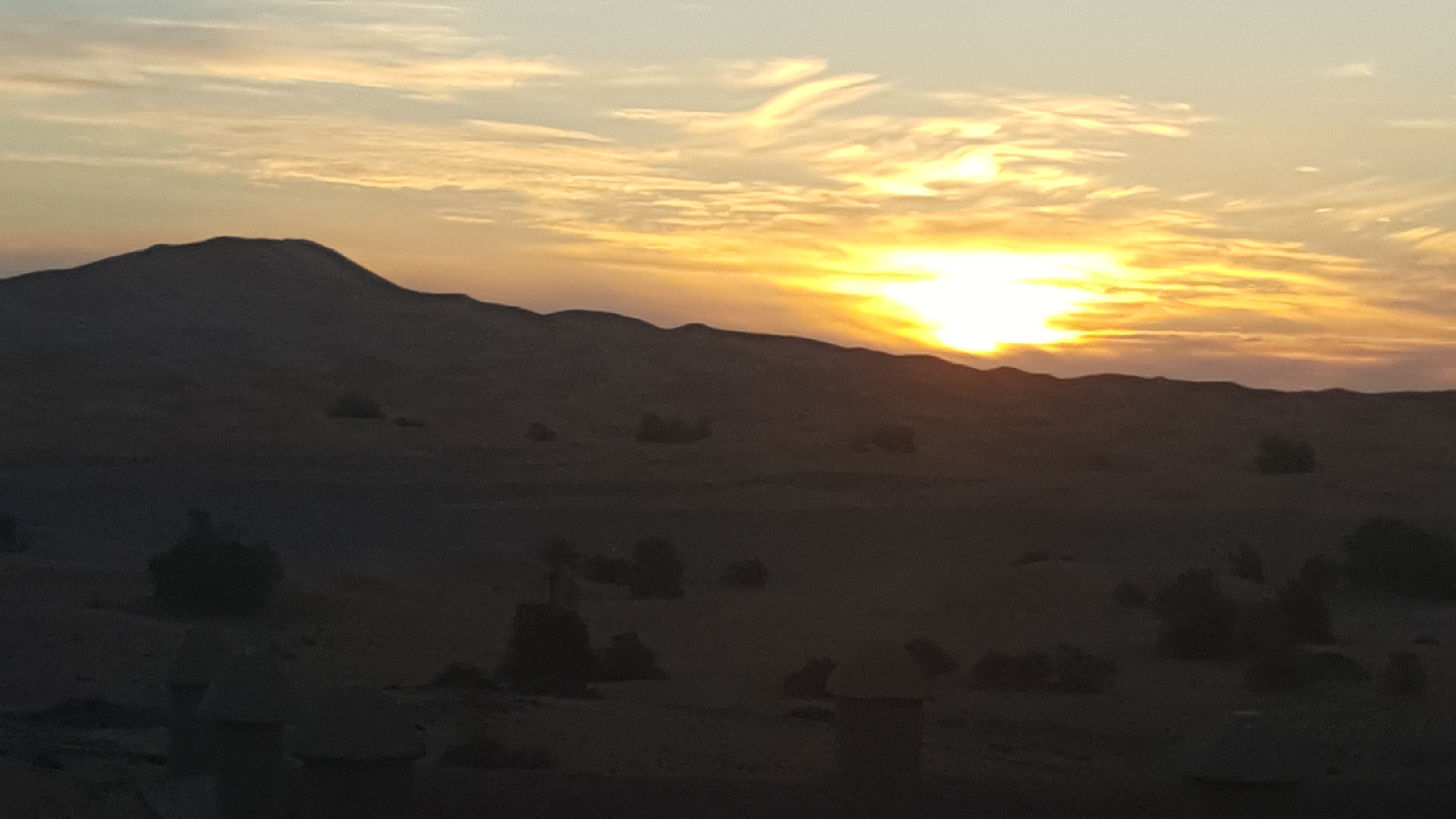
With stomachs almost bursting, it was time to rest. We didn’t even talk much. I got ready for bed and as soon as Elton’s back hit the sheets, he was out. So was I. I woke up early the following day to see the famous Saharan sunrise. It was beautiful. Camels were everywhere. Everything was copper, as oppose to gray before nightfall.
I woke Elton up and we had breakfast before checking out. We were halfway our trip. It was going to be a seven-hour journey to Fes. I was looking forward to it, having greatly enjoyed being on the road.
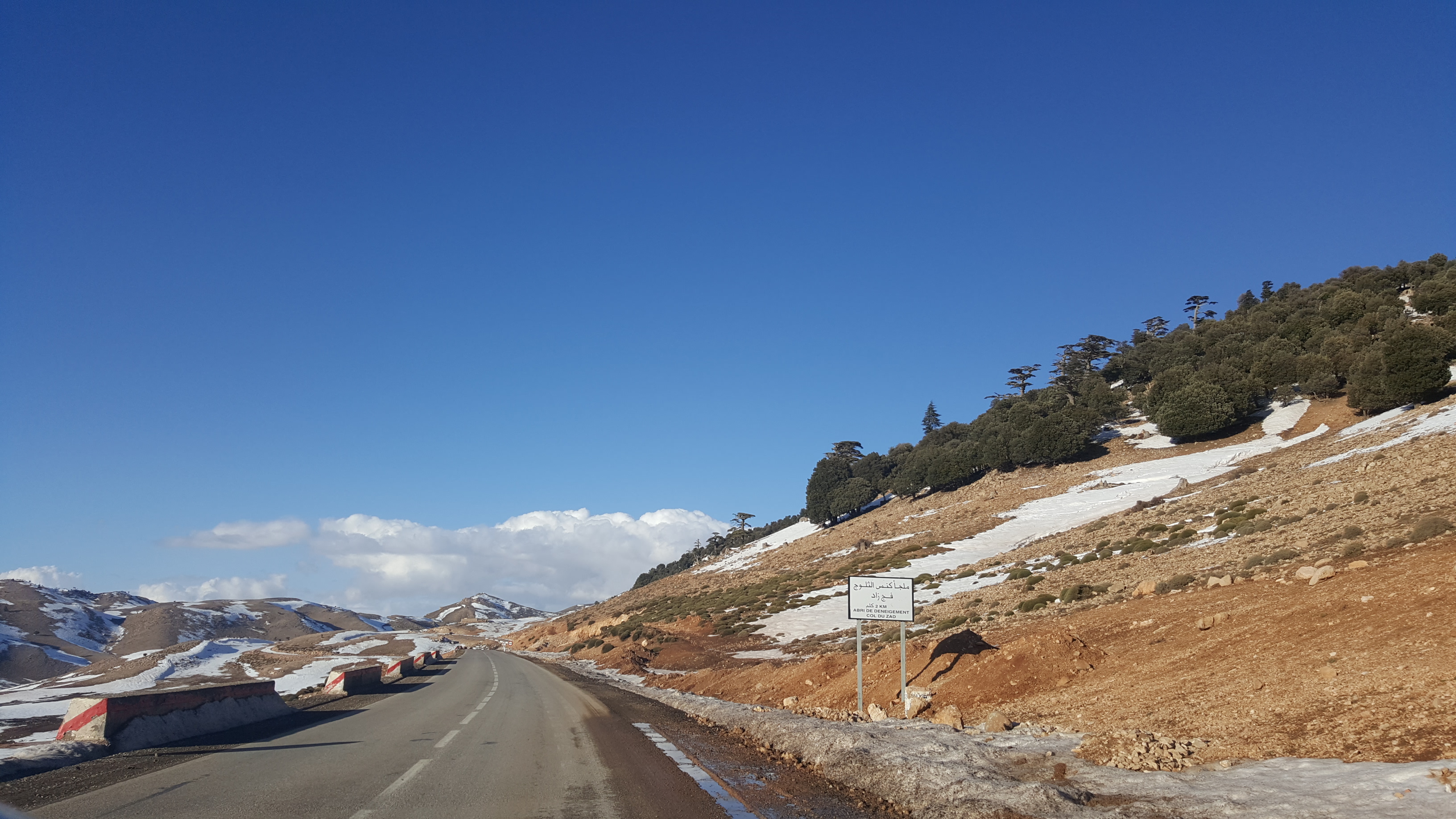
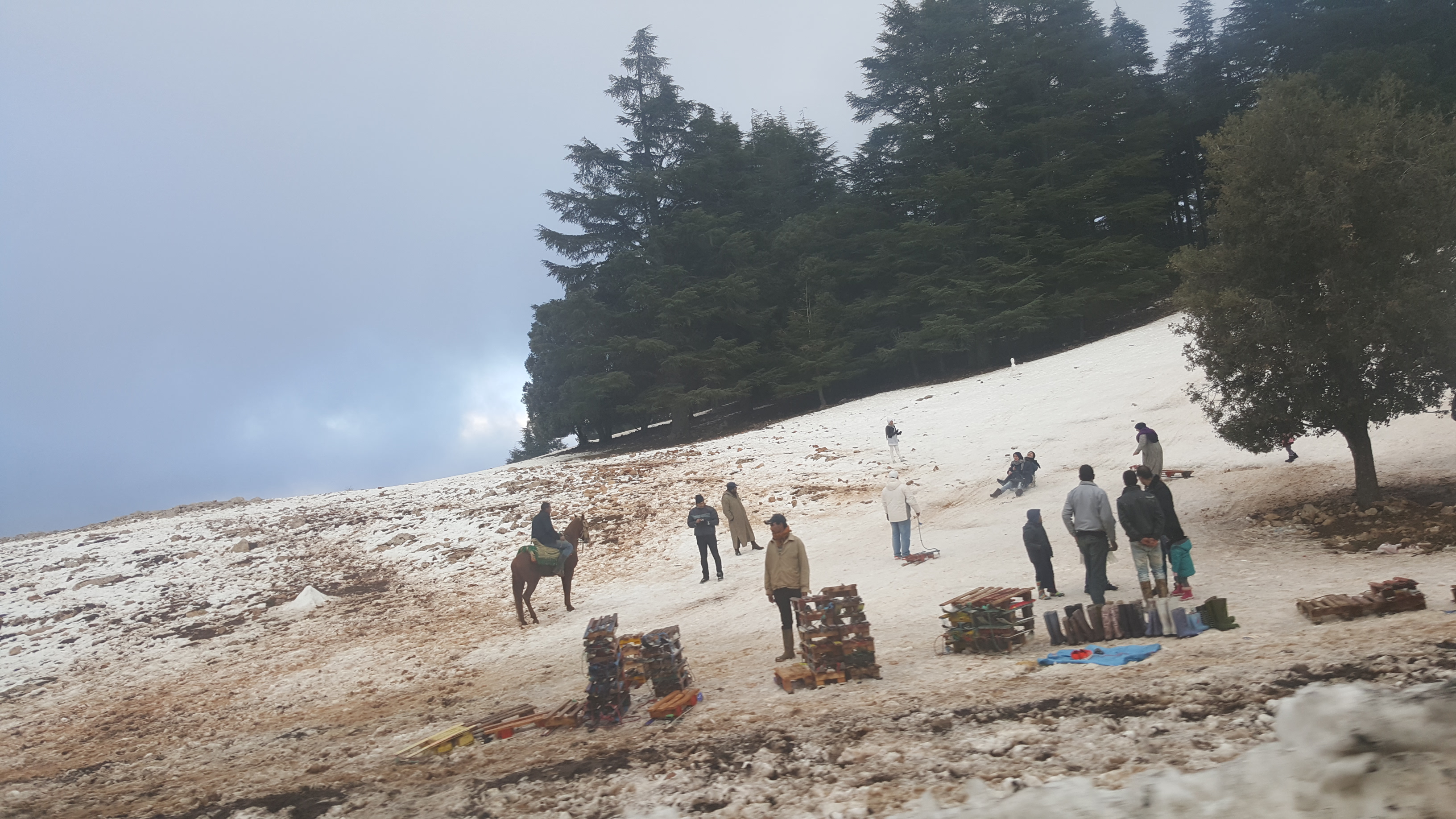
As always, Morocco did not disappoint. We passed by Efroud, Errachidia, Azrou, and many other towns. This was where it got real for me. SNOW!!! SKIING!!! OMG!!! It was such a wonderful first time for me to see people skiing by the road. Elton commented, that part of Morocco was very “European.” The houses were. There were places where people camped by bonfires. It was quite fascinating for me to see.
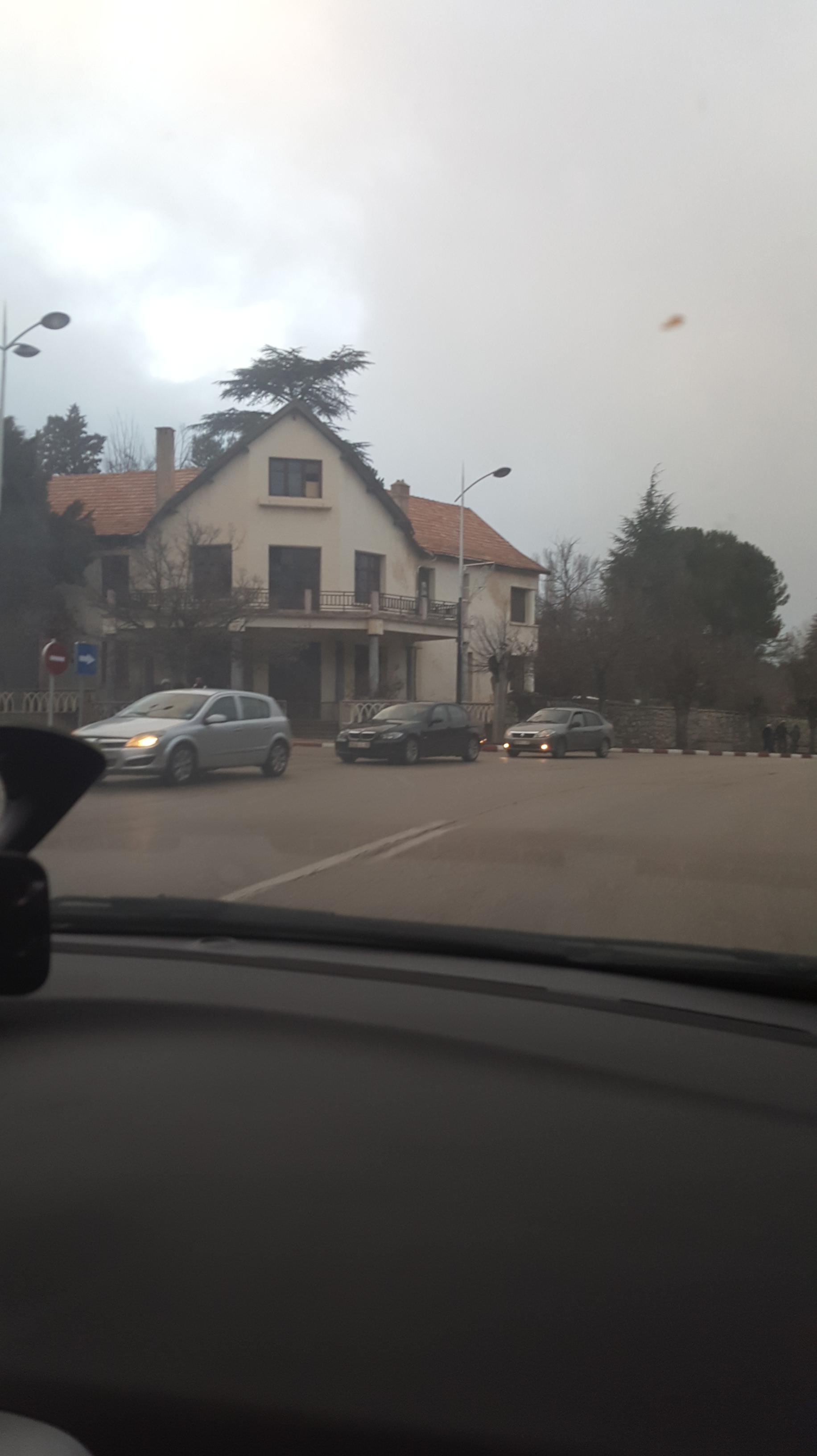
We reached Fes around seven in the evening. We followed Google Maps but couldn’t find our hotel so we called them up and were told that they will send someone over to pick us up. I was getting nervous. If I booked a hotel like the one I booked in Marrakesh, I was afraid it will flip Elton’s bitch switch. In my head, I was weighing the options if the hotel turned out horrible—where shall I book? What will I tell Elton? Should I raise my eyebrows at him before he spoke to force him to keep his thoughts deep, deep inside? I looked at him. He was silent, tired, stomach still upset, while we’re waiting inside the car.
After a few minutes, a nice-looking young man arrived, showing his ID. He was from Dar Mansoura. He took us to the parking area, which was outside the Blue Gate (Bab Bou Jeloud). Parking was easy and cost 20 dirhams/night. Not bad.
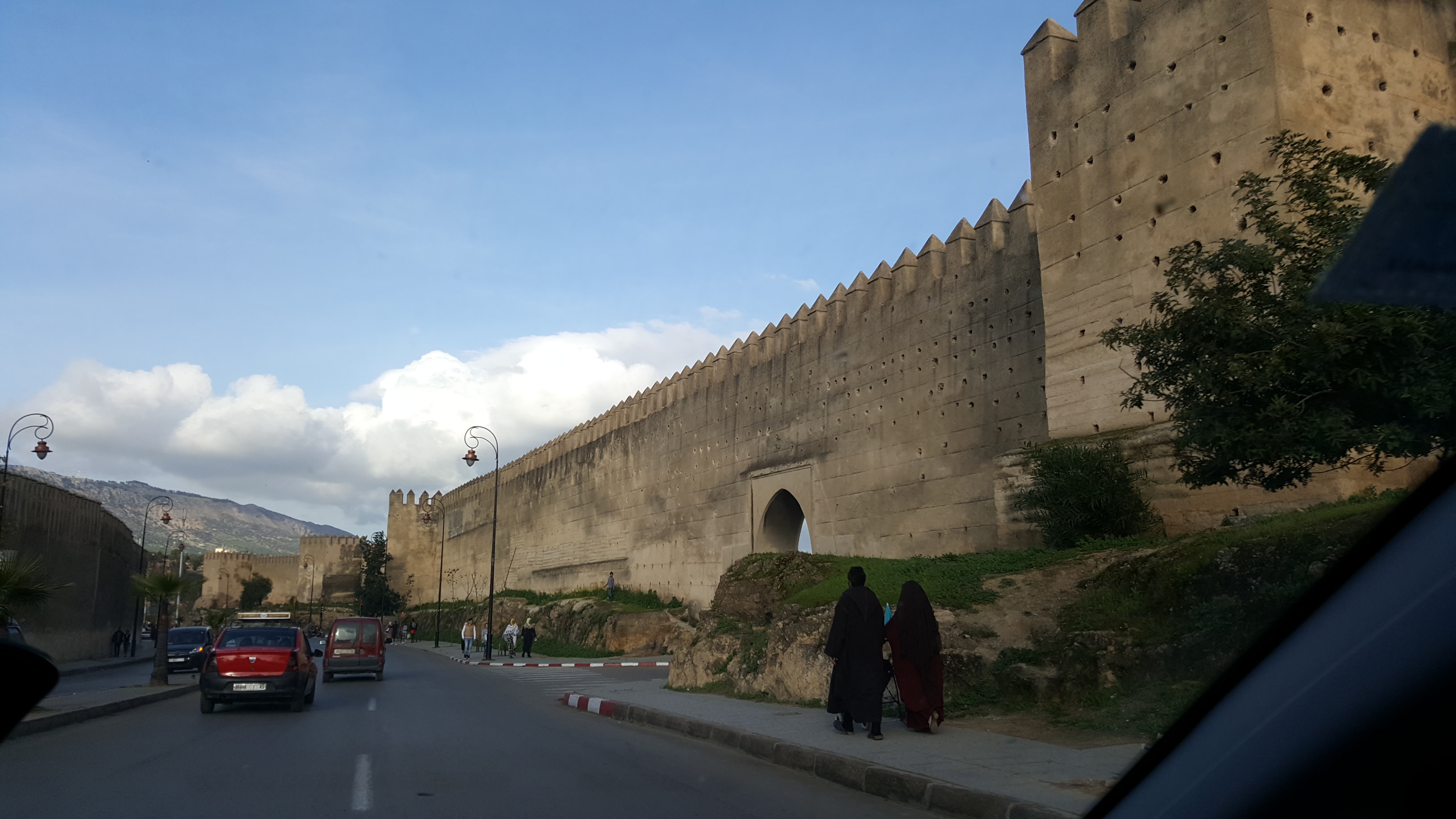
The hotel was located inside the medina, near the Blue Gate—basically one of the entry points to the medina. We passed by a couple of restaurants and stores—leather shops, meat shops, sweets and pastry shops, you name it. The hotel was located not too deep in the medina. It was beautifuland oddly quiet.


Elton seemed pleased. It was not too far from the parking area, and the receptionist was helpful and friendly. Mint tea was served. There were only five or six rooms in this place, all big. After checking in, we headed out to have dinner. We saw a restaurant that offers 50 dirhams (5 euros or P250) for a kebab meal. As we were eating, the waiter said he will give it to us for only 35 dirhams, and asked for us to be kind enough to leave him a handsome tip. We did. Later, we found out that food is not spared from haggling. Of course, I tried my best and got those 60-dirham plates for 25 dirhams `cause haggling is one art my mother taught me well. Elton accuses me of being cheap, I just roll my eyes and try not to remind him that he needed my haggling expertise a few times in Morocco. Again, never be too ashamed to say the price you want to pay. Less than 50% of the total price is ideal.
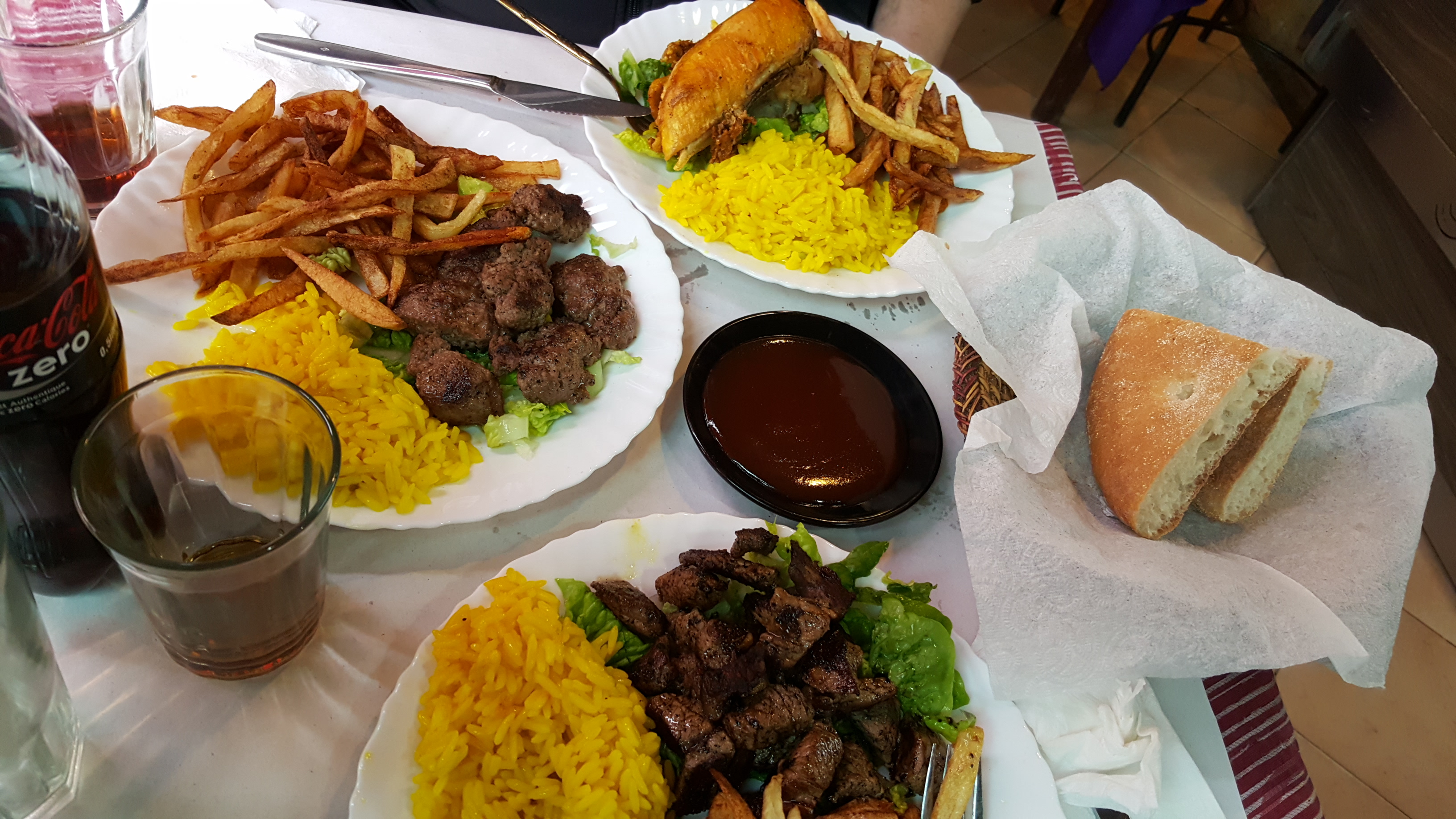
We headed back to the hotel and freshened up. Tired as I was, I wanted to have a little chat with Elton about our itinerary for the next day but as soon as I closed my eyes I fell fast asleep. The next morning, I knew what Elton did as I was sleeping and I was right. He took a video of me snoring from exhaustion. Ah, I shall get my revenge!
[This has not been proofread yet. Please bear with me]
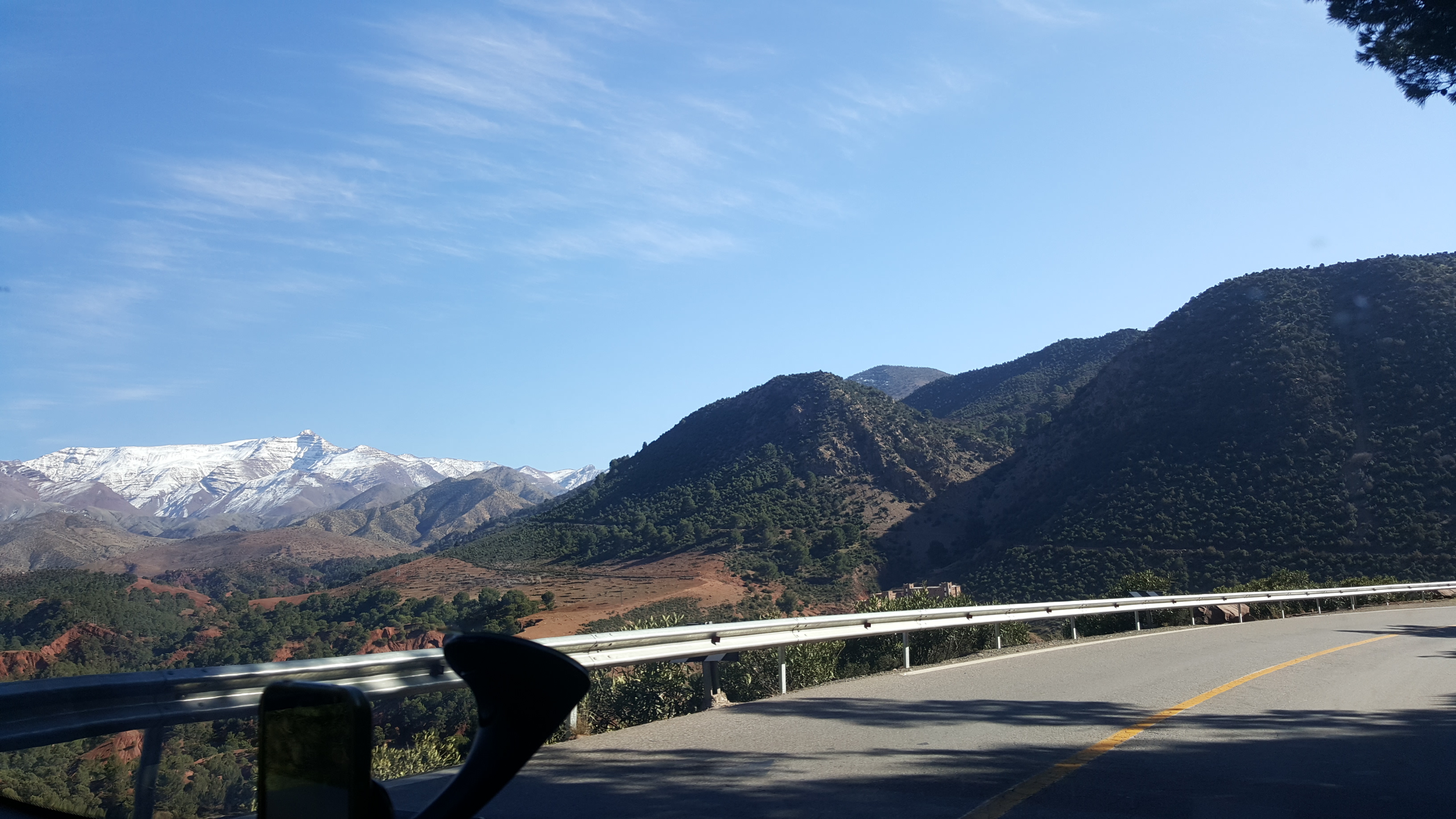
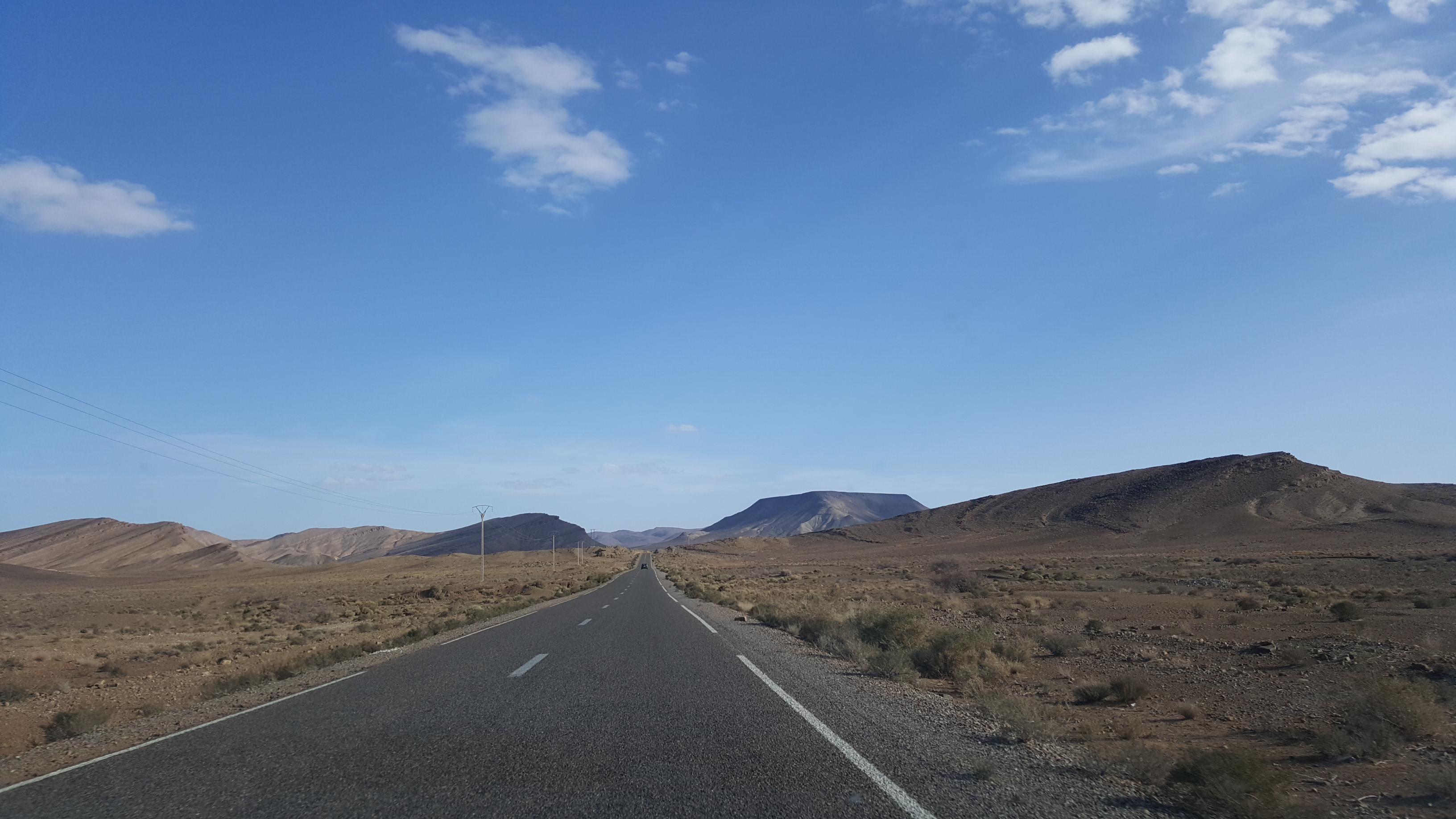
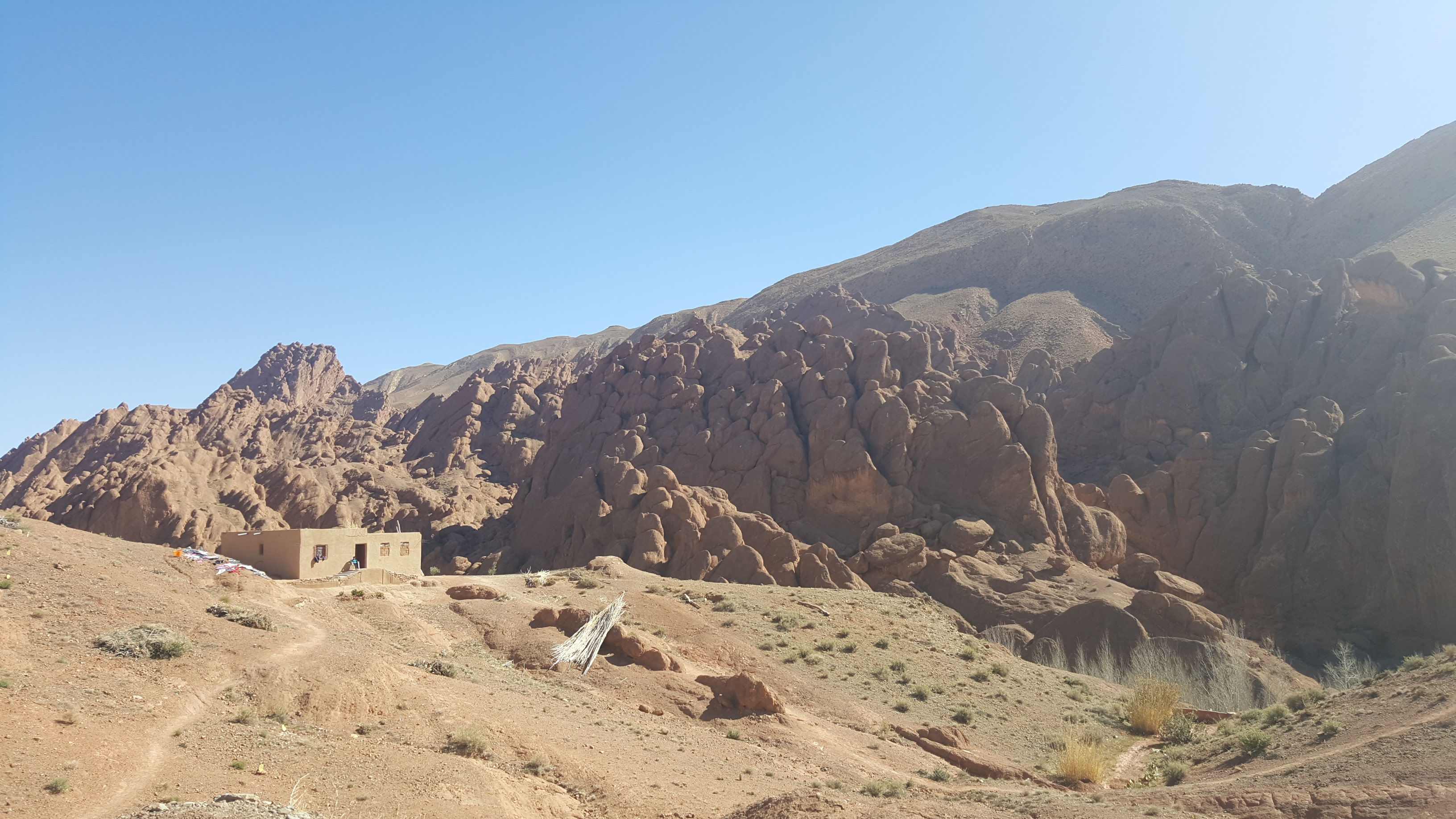
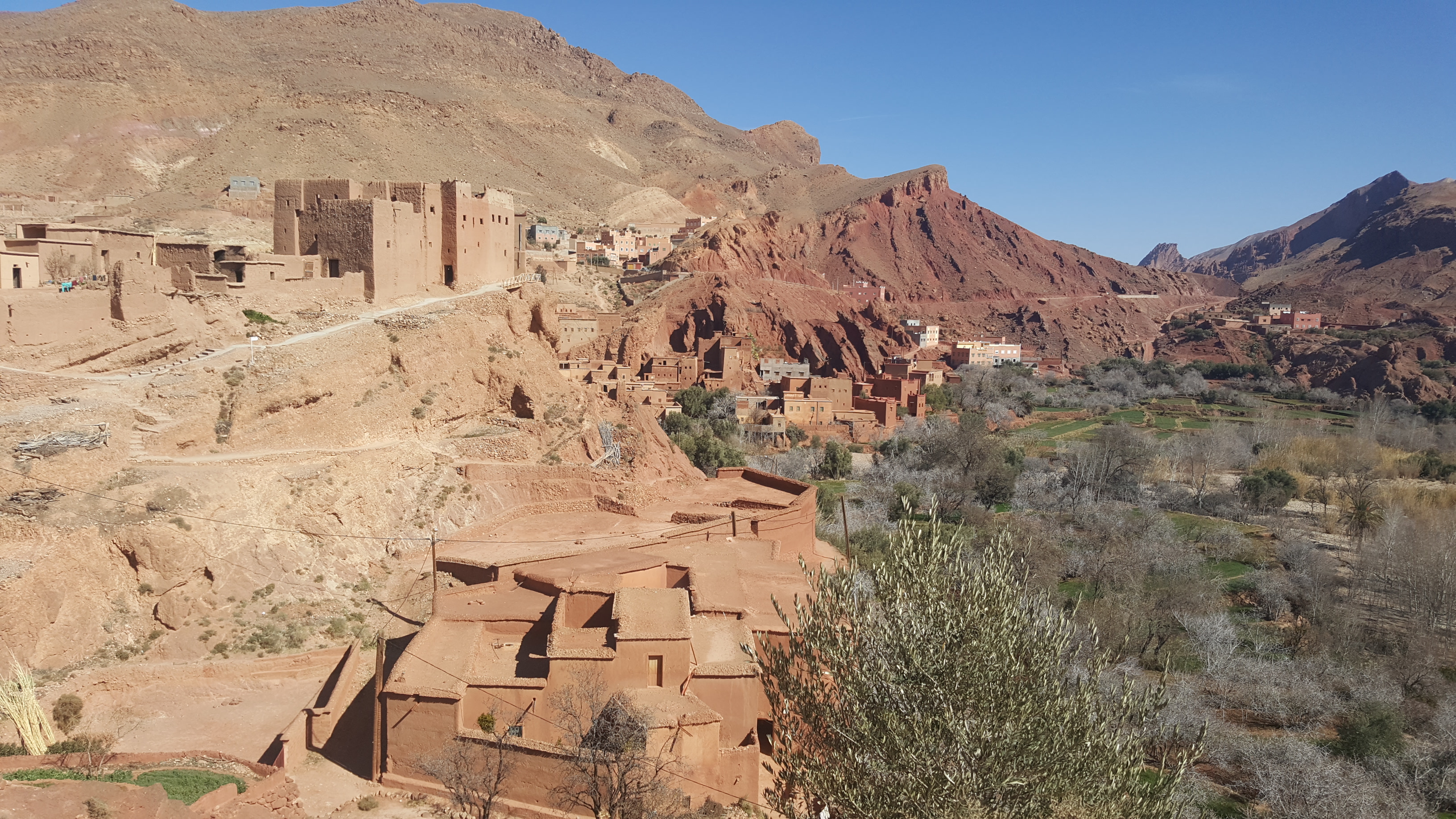
The trip was turning out great. We munched on some pastry bars and the free Moroccan trail mix I got from a souk in Marrakesh. I sang from time to time, and Elton either smiled or smirked, depending on his mood. We talked about travel, life, stupid people. That was fun, too, but time and again, we heard ourselves say, “Look!” or “Wow!” or “Oh my god!” or “That’s so beautiful!” The countryside was a tapestry sewn so intricately by nature, much more complex than the way the Berbers forge silver with wood to create one-of-a-kind trinkets, or how they use the Agave plant that grows abundant to make silk. Having the Atlas Mountain Range and its sub-ranges as a rich and vibrant backdrop was nature’s greatest gift to Moroccans, and Northern Africa, for that matter. If you look at the map, you’ll see that a part of the mountain range and the mountain’s sub-ranges are in the middle of Morocco, which means that you will see and pass through and around them most of your journey if you explore the country by land.
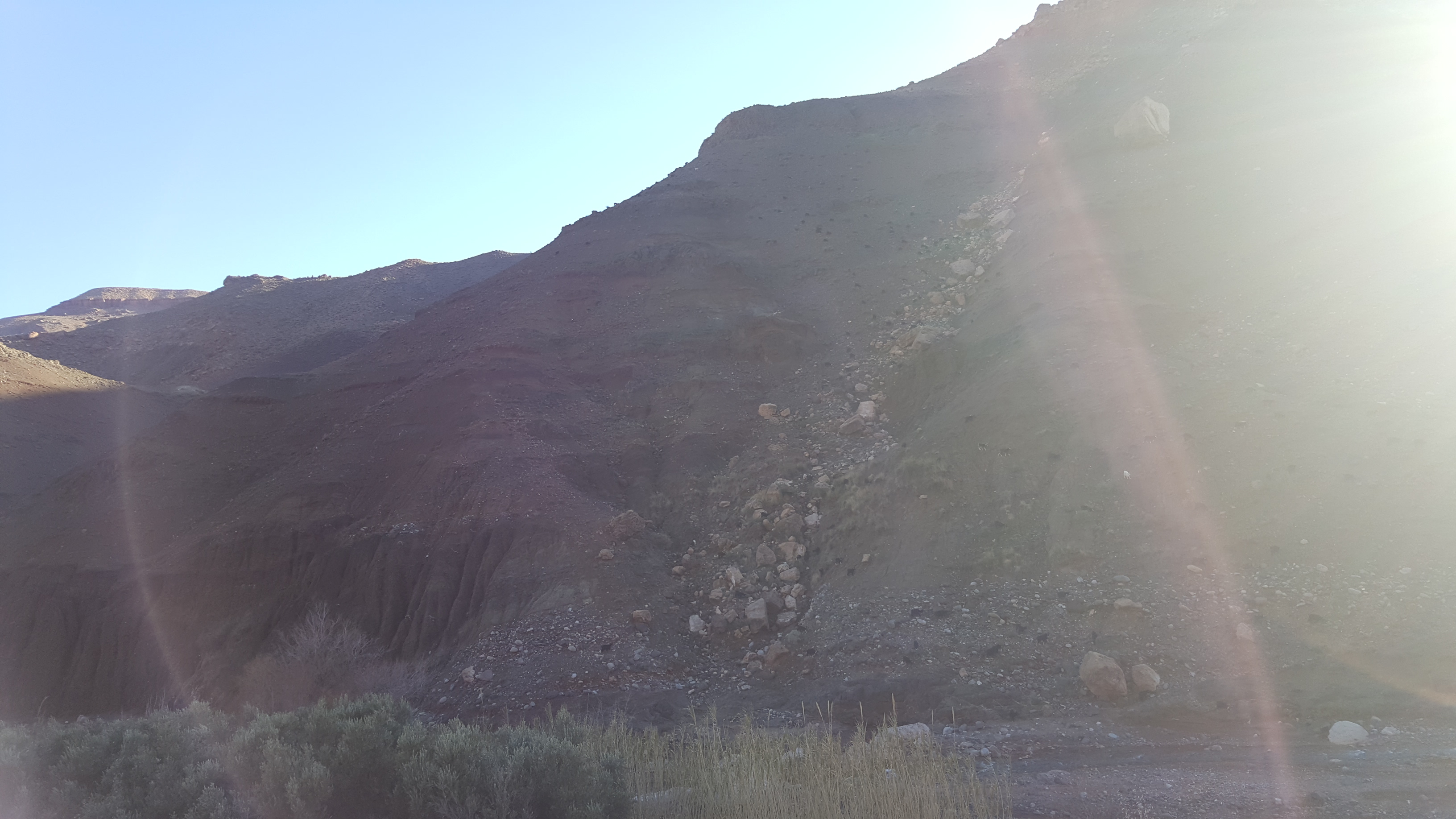
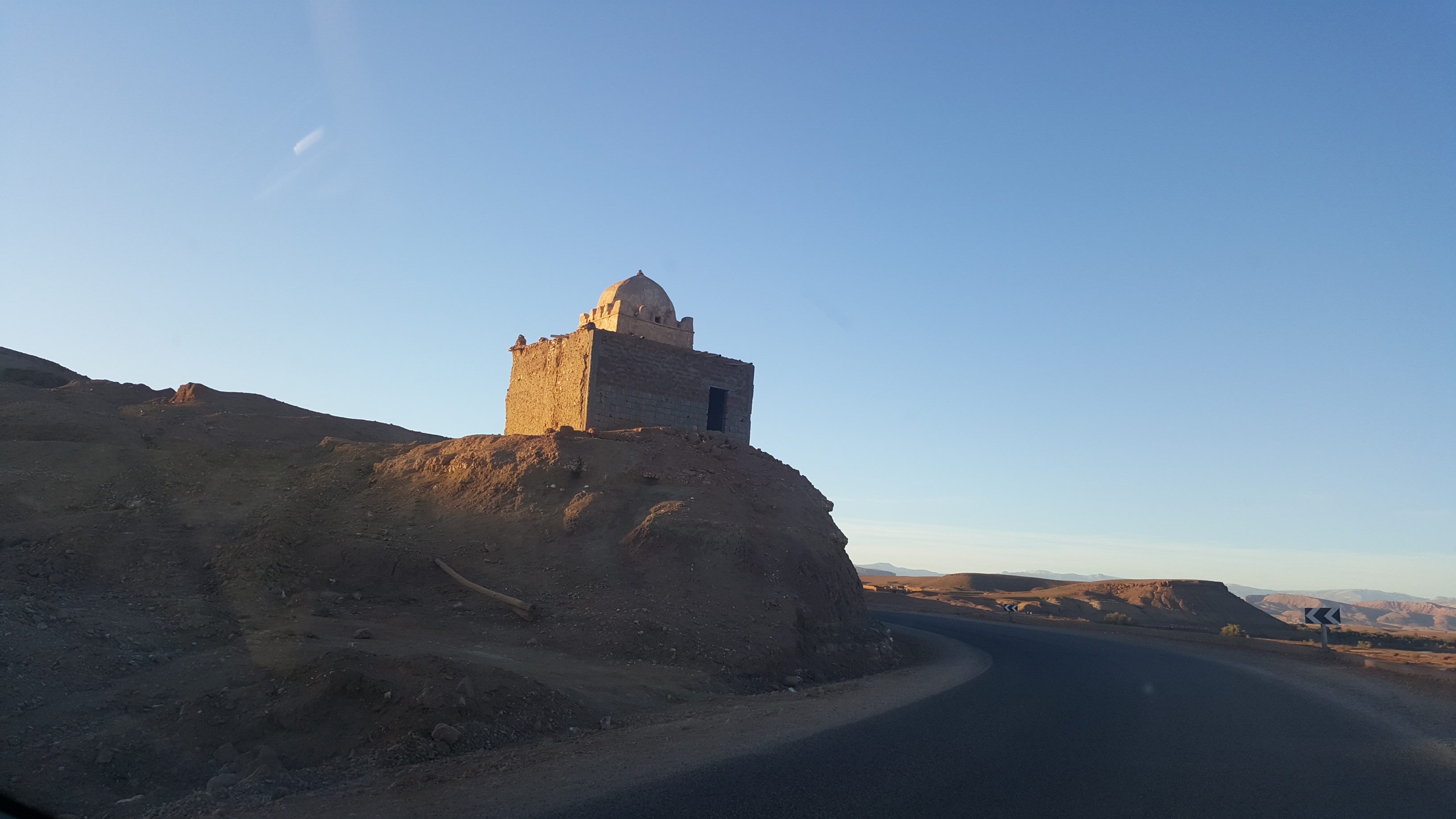
Our itinerary for the day was Essaouira-Ait Benhaddou-Dades. According to Google Maps, it was going to be an eight and a half hour trip, excluding stops. The road to Ait Benhaddou was a showcase of nature’s beauty. I have never seen so many shades of bronze and copper in all my life. I bet the Pantone people will salivate. The traditional houses are a dark shade of terracotta. There are small communities in the middle of nowhere. Most of the time, only a few cars will pass by for miles and miles. I can’t remember how many times I asked Elton how people can live so far from markets and without any visible car to take them anywhere in case of emergency. Not only will you see houses built far from the street without any visible road leading to it (how the heck did they transport the materials to build it?), but there will be hitchhikers along the roads where not a lot of cars pass by. How in the world did they get there in the first place will be your first question. The second will be how they can reach their destination. Herds of sheep can be seen here and there, just strolling like rebels—who the heck needs shepherds, right? We saw a herd of goats almost defying gravity, strutting on a face of what seemed like a plateau (I need to review land forms, I guess). But goats! Are you friggin’ kidding me? I refused to believe they were goats so Elton pulled over to make me look closer. They were indeed goats, almost camouflaged by dirt, except for the black ones.
I also saw a lot of RVs in Morocco. Most of them have European plates, according to Elton.
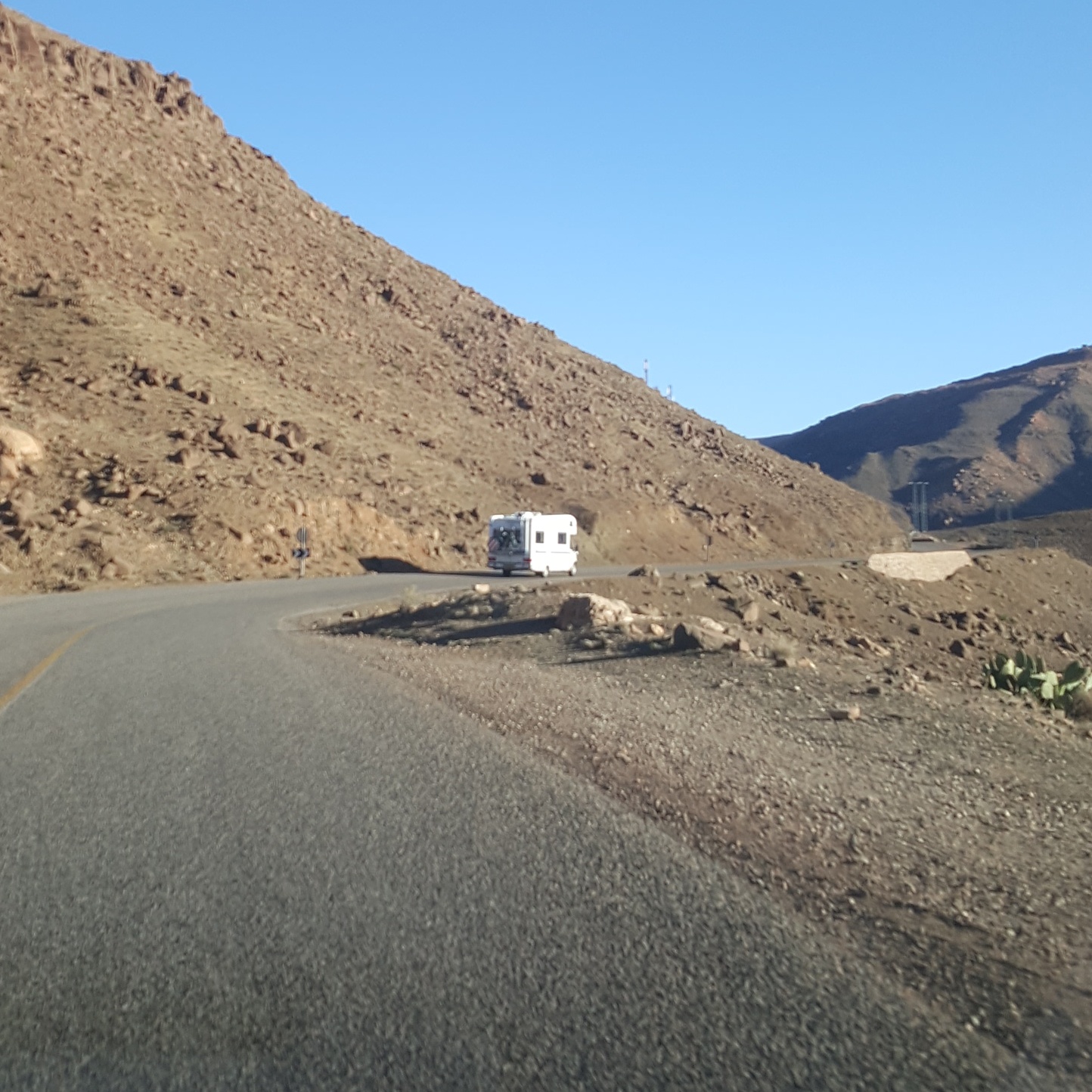
There are a lot of vans as well. Basically, vehicles we see in movies that people use for road tripping. I know that sounds very ignorant but I have yet to see vans and RVs like those in Asia. Elton said that RVs are great for travel in Morocco but not in Europe because in Europe, parking might be a problem. He also said traveling in an RV when it’s cold is hard `cause one would need to keep the heater on all night. He said he traveled in one when he was sixteen. I do pick up a lot of information from Elton, which I feel is worth sharing and can be useful for writers like myself.
We stopped to eat around two in the afternoon, had tagine beef and chicken with bread. In Morocco’s simple restaurants (their version of karinderya, a bit fancier than our simple ones), couscous is almost never served (surprise!). Rice is found here and there but the staple is bread, usually khobz or baguette.


With stomachs full (Elton was having stomach problems but carried on anyway), we hit the road again. The sun was starting to set as we continued on Ouazazate (pronounced war-zazat). The view was absolute perfection, OH. MY. GOD. The sun painted everything copper, gold, and bronze. I was asking myself if it was real because everything in front of me was unbelievable. It was breathtaking. This will be the setting of a new fantasy book, I told myself. It seemed like at any given moment, someone would say “Cut!” because it looked like a movie set in its utter perfection. Surreal. Everywhere I looked, my eyes were filled with nature’s splendor, but they were hungry for more. Morocco only seemed too eager to show off.
It was past five in the afternoon and our hotel In Dades was pre-booked (a few hours away), and we haven’t even reached Ait Benhaddou yet, where some scenes from movies and TV were shot. We decided to stay here for the night. There were a lot of inns anyway.
Ait Benhaddou is a UNESCO World Heritage Site. It is a ksar (a fortified village). The structure is beautiful and shows how the Berbers used to live. Now, only four families live here and tourism has invaded it. There are stores and inns. We saw a couple pulling their luggage up the ksar. It’s difficult and your luggage will be dirty by the time you get to your hotel. You can hire someone to carry your bags for you (for a fee). If you plan to get to the Sahara from here, there are tour agencies (some authentic Berbers) offering camel treks to the desert.
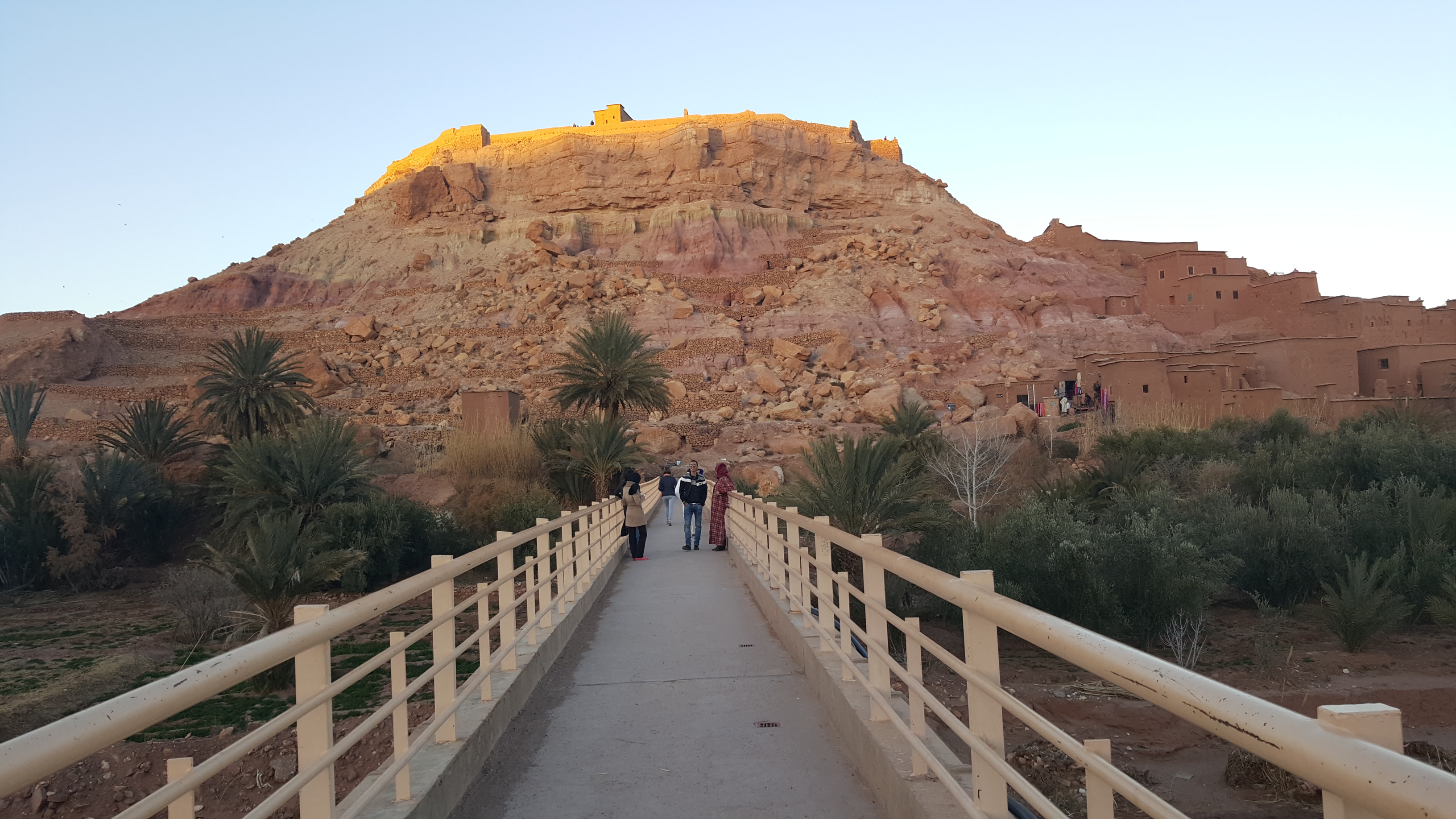


We didn’t spend a lot of time in the ksar. We needed to find a place to stay for the night so we searched for one. Along the way, we saw an inn that looked nice enough. The receptionist said the price per room was 50 euros. By this time I was already learning the art of Moroccan haggling so I told the receptionist that technically, we will only spend a few hours there since it was already seven in the evening, therefore, he might want to give us a discount. He agreed. From 50 euros, the price went down to 20 (P1,050.00). It came with free breakfast. Good deal.
We freshened up a bit and headed out to look for a place that served dinner. The road was very dark. Elton noticed that the stars seemed brighter and larger here than in Italy, where he’s from. I read this same observation in a book by an American author. I didn’t notice anything different, which made me think that foreigners in the Philippines probably think stargazing is “more fun in the Philippines.” I will let you know once I go to either Italy or America. Haha!
I didn’t like the idea of driving far away since it was very dark so when I saw a restaurant that looked lovely, I asked Elton if we can check it out. The place was called Kasbah Isfoula. They served a mix of Moroccan and European cuisine. Elton had steak in blue cheese gravy and wine; while I tried their pork Milanese and Coke Zero. I know, I’m so rock and roll and Elton is so sophisticated. He didn’t even order wine to be fancy. Haha! I need to be schooled in sophistication, I guess. I’m not a fan of wine, and I hope Elton doesn’t convert me into one `cause my friends will raise their brows at me if I ask for a glass of fine vintage as I eat my rice and chicken adobo. Elton knew I disliked blue cheese but he made me try his steak with blue cheese sauce. I suspected he wanted to prove a point and make me a blue cheese fanatic. He succeeded. Credit goes out to Kasbah Isfoula in making me see the light. The meal was delicious! And the plates? Gorgeous.

I wanted to buy their plates but they said they weren’t for sale. I said “please” and I guess the waiter got amused and returned as we were getting ready to leave to hand over a plate. Very, very nice people. I love this place. Next time, I will eat here again.
We went back to the hotel after a lovely dinner. By morning, we had our breakfast and headed to our next destination—the Sahara Desert, Erg Chebbi. But first, we must see Dades Gorges. Elton was very interested when I showed him the photos of the road with hairpin turns. Funny thing, we were already in Dades but we still weren’t aware we passed through the famous road until we stopped to look at the view. It looked exactly like it does in photos. That’s the thing about Morocco—you don’t need Photoshop!
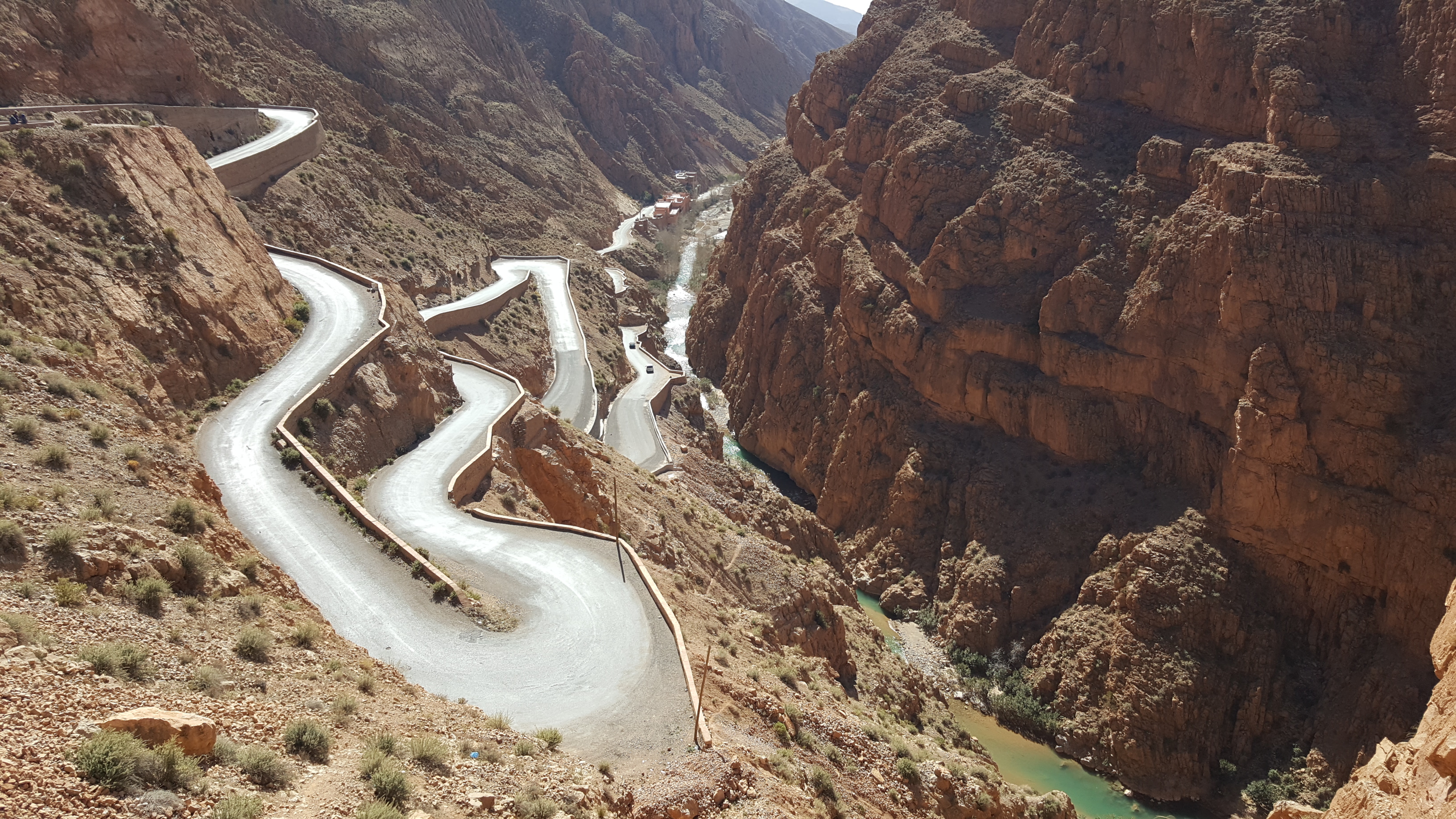
It was around two in the afternoon. We saw a van with an Italian plate and Elton talked to the guy about the road condition headed up and was told that the guy had to turn back because a part of the road was closed due to snow, plus we will be behind schedule if we continued on this road to get to Merzouga and see Erg Chebbi. The Sahara, finally. I can hear Anggun singing in my head… “If your hope scatter like the dust across your track, I’ll be the moon that shines on your path… The sun may blind our eyes, I’ll pray the skies above… For snow to fall on the Sahara…”
Arriving in the kasbah in Merzouga, I never thought that it was so cold that it was not entirely impossible for snow to indeed fall on the Sahara! But I shall talk about that on my next entry.
After breakfast in Marrakesh, Elton John and I prepared to leave. We took a leisurely walk to the parking area and I bought nuts. It wasn’t very cold that morning, perfect for the trip.
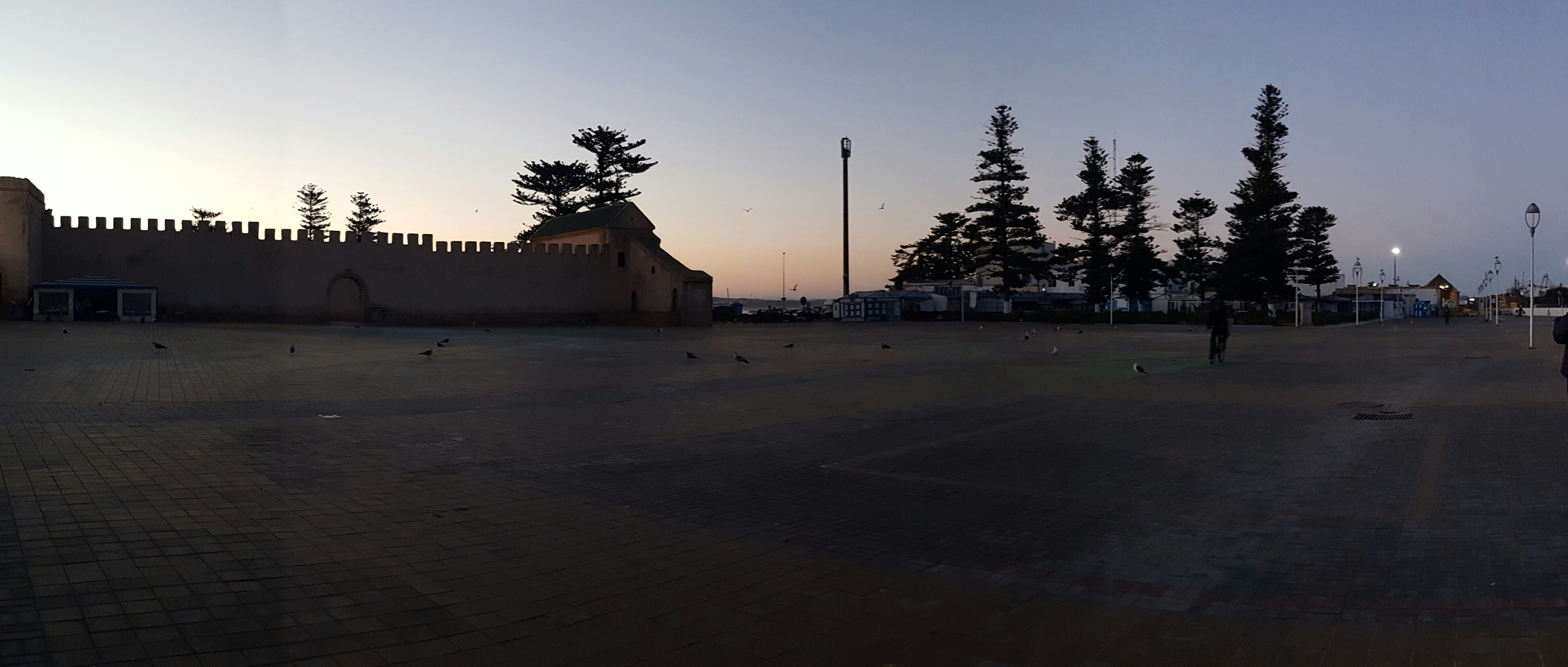
I wanted to see Essaouira (Sor-yah/Esor-yah) mainly to see where they shot some scenes from Game of Thrones. Elton was in charge of navigation. Google Maps wasn’t working well but Here app was great. I didn’t even know about that app until I saw him use it. Everyday, he stuck his own phone holder on the windshield. From the app, we can see the map, time of arrival, speed, kilometers reached, and speed limit of the road. It beeps when you go 10 kilometers above the limit. Isn’t that amazing? Elton prefers Google Maps but I think Here is great.
I saw a lot of Argan trees along the road from Marrakech to Essaoiura. The view is awesome—rolling hills, summer shades everywhere, snow-capped mountains. When you get to the Citadel of Essaouira, you will see the Atlantic Ocean. Seagulls everywhere. We parked near the walls of the Citadel, beside the stretch of seafood restaurants where the fresh catch of the day is displayed. You will choose which ones you like and have them cook it. The price was higher than ours in the Philippines, but not by much (if we’re eating Dampa-style, similar to this). They eat seafood with bread, which was perfect for Elton but not for me. I asked for rice but they didn’t have it. We had fish and shrimps, which Elton couldn’t get enough of.


After our late lunch, we tried to look for the exact place where GOT was shot. We took photos of the ocean. It was cold but who cares? I was in awe. The ocean and the walls were picturesque. After a while, a guy with a tray offered us pastries and “happy cake.” What makes it “happy” is hashish or hash. Elton bought a few bars of sweets, the regular kind of course, and asked the guy where we needed to go to see the blue boats I saw on Google and the GOT shoot location. The guy told us it was near the cafés a few meters away. We headed there and found a small street lined with artisan shops and inns. It was an artsy street. I bought a Berber plate (50 dirhams but was originally priced at 130). Elton was invited inside a Berber shop where we chatted with the owner. Elton wanted to buy silver rings but didn’t know how to haggle and so I haggled for him. The Berber guy was tough and said that I haggled like a Berber woman. We weren’t convinced with his prices and so we started to leave. Once outside, the man gently held Elton’s arm and told me to stay out of the shop as a joke because he couldn’t convince Elton to buy anything with me there. So I stayed outside and they talked in Italian. Moroccans speak a mixture of French and Arabic, by the way. There are a number of them who speak Italian as well. Elton can speak English, Italian, French, and a few other languages.
Elton kept looking at me, smiling, probably because the Berber guy was telling him I was too stingy. They struck a deal and I went inside. I swear I could’ve gotten those rings for much less. I ended up buying a silver ring with a big turquoise setting for 80 dirhams (P400 or 8 euros). And I don’t even use rings! That Berber guy sure knows how to sell his stuff! I ended up giving the ring to Elton. That would look nice on his girly fingers!
The Berber man seemed to have liked me and decided to dress me up as a Berber woman for our amusement. It was a fun experience. For a few minutes, I was Vanessa of Arabia. I wish I used kohl to make my eyes bigger and more Berber but my eyes are simply so “Ni hao.”


It was getting cold and we decided to look for a place to stay for the night. We searched online and decided to check the place out. There is a medina down the road. And it was lovely. The leather items here are also cheaper than those in Marrakesh. We didn’t get to the hotel we saw online. We saw a riad that looked nice as we strolled down the street. It was 500 dirhams per room (P2,500 or 50 euros). There are cheaper options in the area (and a lot of luxurious ones as well), but I personally prefered this one. Having booked an awful riad in Marrakesh, which Elton ended up paying for, I thought he deserved a nice place to rest for the night. This riad is called Maison du Sud. Parking is a bit far. The riad receptionist called a man who owns a cart to help us with our luggage. The service cost 20 dirhams (P100 or 2 euros)
Though the riad was right beside a busy street of the medina, it was peaceful at night. I think Essaouira is a very tranquil place, however bustling it becomes during the day. The medina is quite small for Moroccan standards and not as (beautifully) chaotic as Marrakesh, or Fes even. In fact, you know what, even if I can’t say that I’ve explored Morocco extensively (not even close!), I think I like Essaouira best. The combination of the ocean, the charming medina, and the artsy vibe you can sense but doesn’t get on your grill at every turn, just makes me feel nostalgic and romantic. Oh, but what of Fes, Oarzazate, Merzouga? It’s so hard to choose because Morocco is just breathtaking and sublime one would have to wonder why it’s not a popular tourist destination among Asians. Even Elton, who isn’t easily impressed, couldn’t believe how beautiful Morocco is.
We looked for a place that serves dinner. It was nine in the evening and a lot of the shops were closed. We found a nice restaurant that served couscous and rice. It was a good dinner. We headed to the riad after to rest.
I woke up early the next morning, determined to find the place where they shot GOT and see the blue boats that look so damn pretty in photos. At seven, I woke Elton up and we headed out in search of the place. Apparently, it was right beside the spot we were taking pictures from the day before. The hashish guy pointed us to the opposite direction! Now that I think about it, maybe it was because we didn’t buy his “happy” cake!


The morning breeze, the seagulls, the peace and quiet, with most shops still closed, made Essaouira heavenly. I saw the GOT shooting location and the blue boats (went live on FB, too). They look exactly like they do in photos.
A fisherman introduced himself and showed us around, explained how they fished, told anecdotes—in a mixture of Arabic, French, Italian, and English. Elton translated the fisherman’s words, while I translated to him what the fisherman wanted for the “tour.” Elton said nah, the man was just trying to show tourists around. Until we said goodbye and the man asked for some money. We gave him 40 dirhams, but I bet 20 would’ve sufficed. All’s well, it was a good morning. We headed back to the riad and had our free breakfast. We prepared for the day’s long trip to another GOT shooting location.
The man with the cart helped us back to the car. I bought some food to take on the road—pastries, chips, water, soda (around 100 dirhams or P500.00 or 10 euros). We started for Aït Benhaddou.
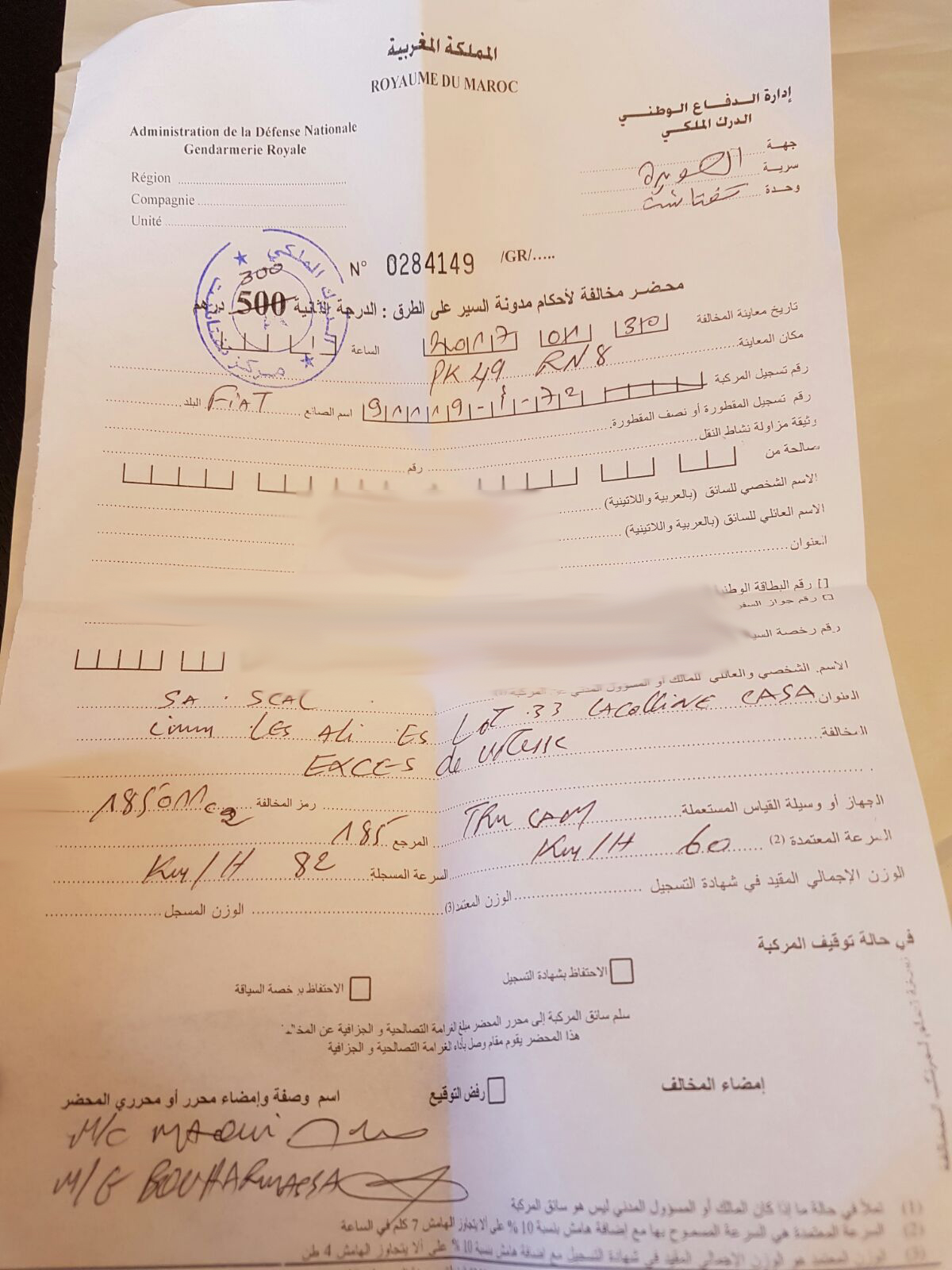
Unfortunately, Elton drove a bit fast near a town center and a police officer with a radar asked for his license and the car’s documents. The ticket was worth 300 dirhams or P1,500. Time and again, there will be police officers on the road. Motorists will usually flash their lights if there is a police officer and you will be warned. Anyway, speed limits are reasonable and road condition is good, the view even better. I swear it.
Still a great day for a road trip despite the ticket. As he drove, I sang along his weird playlist, from Dire Straits to Pavarotti, and an occasional Bon Jovi. Okay, okay, quit badgering me! I sang along only to Bon Jovi. Wouldn’t you, too, on a road trip while Jon-jon (we’re close ’cause we dated in high school) sings, “And I swore, I’d never let you go… Togetheeeer… foreveeeerrr… Never say goodbye! Never say goodbye”?
[The second group of photos and the speeding ticket photo belong to Elton.]
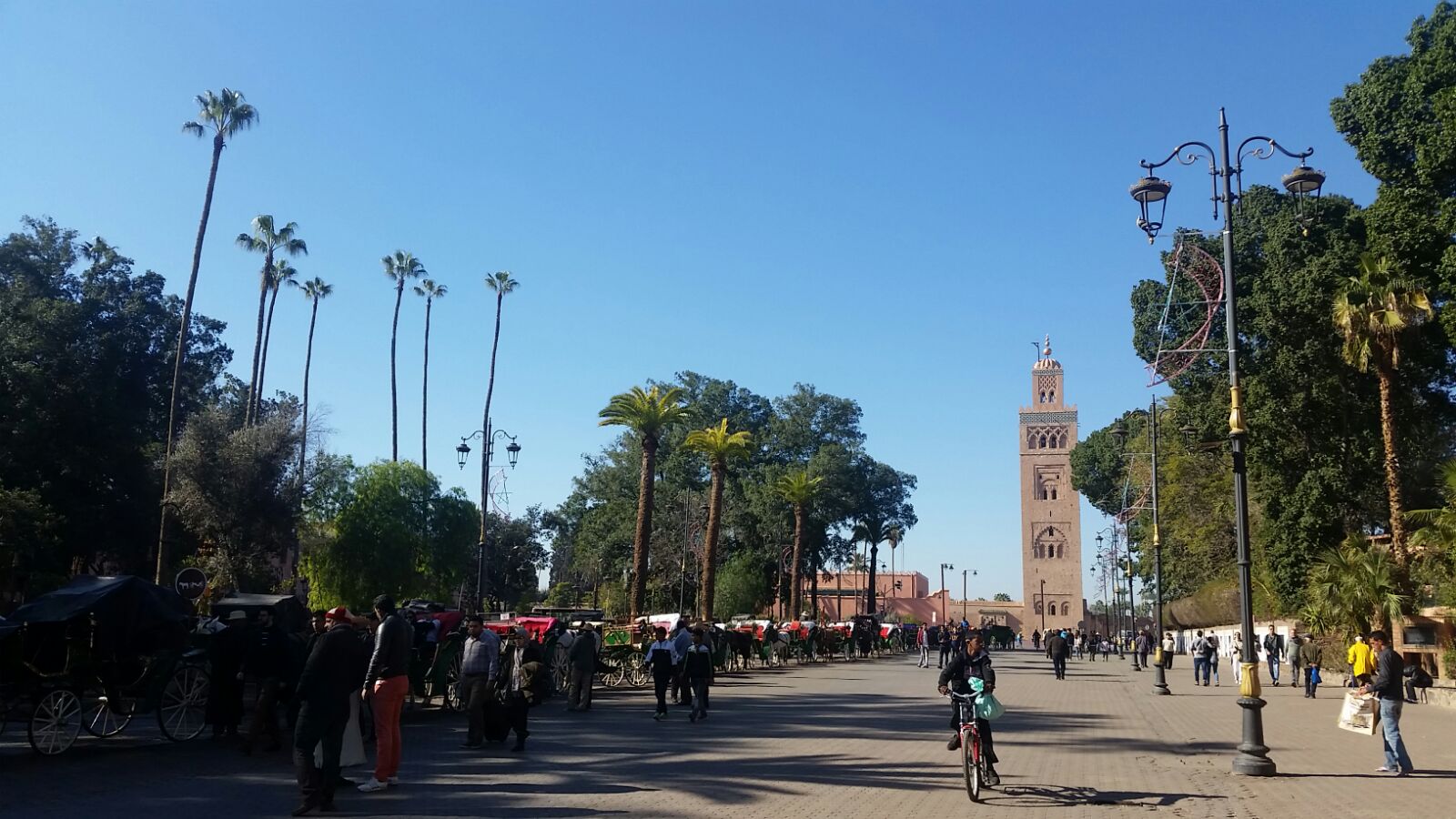
A lot has been said about Marrakesh. Some love it and keep coming back, some suggest a short visit. Marrakesh is everything people have said about it. It’s a place you need to experience for yourself to know what all the fuss is about.
Most of the time, when people say “Marrakesh” they mean the Old City, not the town itself. Tourists head to the Old City to see Jamaa el-Fnaa and the surrounding areas. It is madness. Too surreal, too real, too loud, too busy, too beautiful, too antiquated, too colorful, too much.
The streets of Marrakesh wouldn’t be like anything you’ve seen before. So many streets, very confusing. It’s like a maze. Just when you think you’ve almost reached a dead-end, you will see another street that leads to several streets, all leading some place else. The souks get more colorful as you get near the Big Square.


I walked the streets with souk owners saying, “Konnichiwa.” I think not a lot of Asians come here and those who do are mostly Japanese, Chinese, or Korean. I know because several times I’ve been asked what kind of Asian I was (and no, I didn’t take offense). When they guessed, they always said Japanese first, then Chinese, then Korean. Always in that order. My travel partner sometimes told souk owners, “She’s from the Philippines. Do you know where the Philippines is?” Guess how many of them actually knew? Not a one. Well, being Asian worked out great for my visit because when touts or insistent merchants approached me, I just put on my I-don’t-understand-English-and-that-is-why-I’m-smiling-like-this face. It worked well a few times, but to two touts who followed me as I headed to Jamaa el-Fnaa, I had to say with an “Asian” accent, “No English, no English” with hand gestures to match.
Moroccan breakfast is rather simple—jam, butter, tea, yogurt, and sometimes eggs and processed cheese. Bread is always served. So many bread! Brioche or croissant, flat bread, cakey bread, baguette, pancake, and the Moroccan staple khobz (a round bread you can find anywhere and comes in many sizes, 1 to 3 dirhams each or 5 to 10 pesos). My favorite will be the flat bread, similar to India’s naan, or Malaysia’s roti. I happen to look for a protein source in the morning so I always headed out to look for something more “Asian” for brunch. For two days, I ate in a place a few minutes walk from the big square. They serve several kinds of bread, lentil and bean stew, and my favorite—chicken cooked in tagine.


I walked the streets, mainly enjoying the plethora of items for sale. It’s not unusual to find a donkey strutting alongside you. It will be more fashionable than you can ever be, totally rocking its colorful gear. It is normal for butcher shops to be right beside a shop selling mobile phones or clothes. I liked strolling along the street where all the nuts and dried fruits are sold. I have never seen so many dates my whole life! Heck, I couldn’t even find them in groceries back home! They taste so normal and not overly processed and sweet. When you buy nuts, the souk owner will give you a handful of anything you like to nibble as you continue your stroll. After buying dates, almonds, and walnuts, I had a Moroccan trail mix that lasted for two days. Good deal. Almonds and walnuts cost 100% cheaper there, too. Bakers, take note.
The leather shops will make you wish you’re a millionaire. There will be tons of bags you would want to take home with you. Don’t let the price discourage you because haggling is an art form in Morocco. I didn’t try in Marrakesh but in Fes, you can haggle in restaurants and it is the norm.
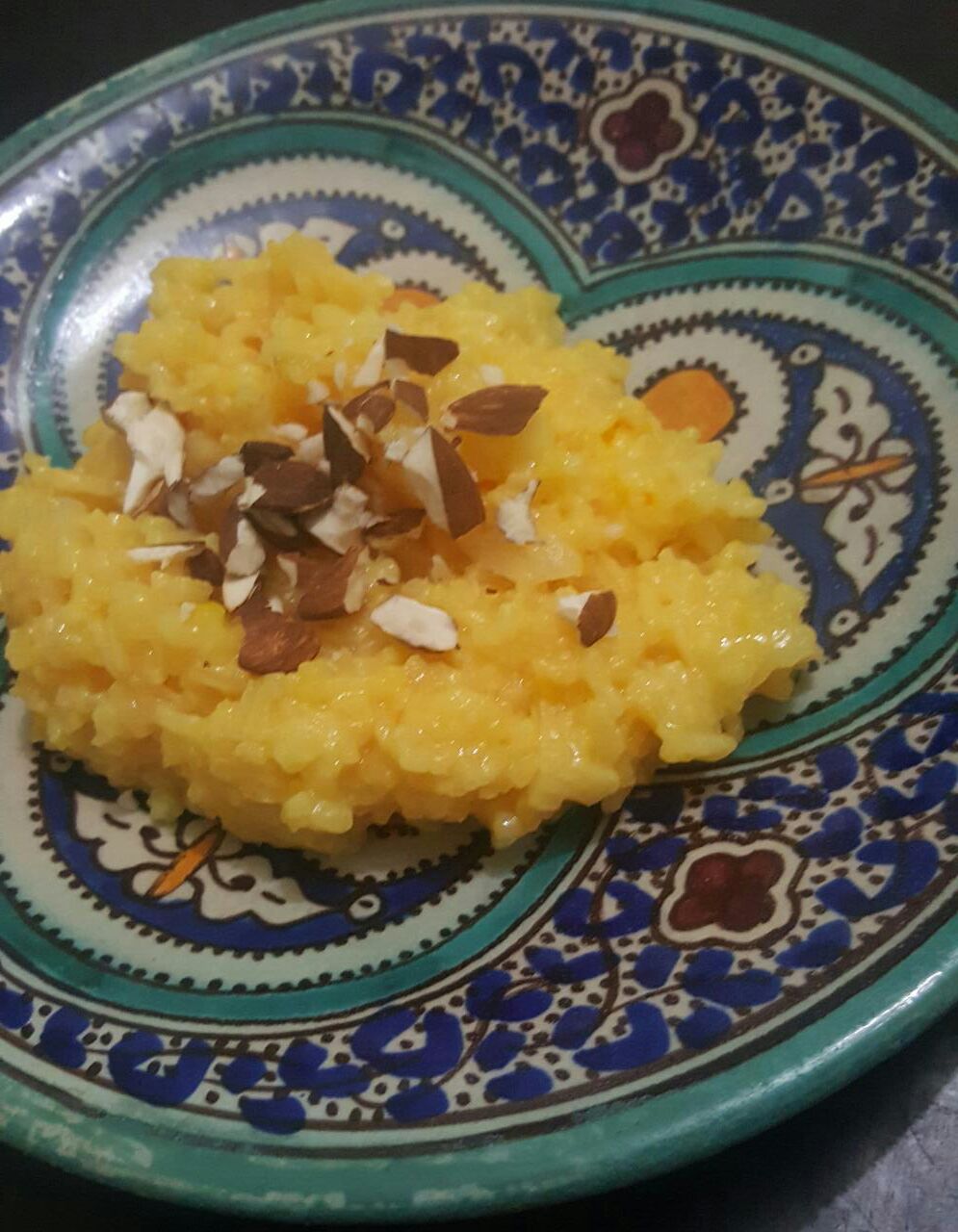 I tried avoiding the ceramic shops but it was impossible to resist them. See, I love kitchen items. Earthenware is my weakness. And Morocco is earthenware paradise, OMG. Once I started, I almost couldn’t stop. I wanted to buy everything but I had to remember that I set a budget for shopping and I shouldn’t exceed the limit on my first destination.
After my daily stroll, I always came back to children playing on the streets outside my inn, wearing their cute little leather boots. They always waved at me, shy at first but all it took was a smile to get them to say “Bonjour!” I always said “Bonjour!” back and gave them a wave. I guess I felt like what foreigners do in the Philippines when kids come to them to say hello in a curious manner because they look very different from us. I will obviously stand out in a place like Morocco. Most tourists are European. The streets were noisy with every language I couldn’t understand.
I visited a tannery beside the inn. I never knew there was one until the innkeeper told me. One morning, I decided to check it out. It was drizzling. I entered the huge gate and a man wearing a cloak said “Bonjour!” He did not speak English so I gestured if I could come in. He nodded with a smile and led me into a tiny shack. It’s like stepping into a different time when I entered that 2.5 x 5 meter shack. In one corner, a man was scraping leather with a tool I have no idea what to call. Like a half-moon blade-sickle of some kind. In the other corner, there was a tall stack of leather. I took photos and bought leather for 100 dirhams. Journal making would be more interesting using real leather not faux suede, I bet.


Moroccans are gorgeous, by the way. Most of them are reasonably attractive and a lot are simply beautiful. Fashionable, too. Gentlemen in suits selling fruits or ceramics, dudes in leather jackets and boots, ladies in colorful and elegant caftans and hijabs. Anyone would want to dress up here!
TOUTS
They are everywhere and come in all shapes, age, and size. From attractive, decent-looking men calling out to you, “Madame, Madame, how are you today? Speak English?” to kids saying, “Good morning, Madame, do you need a guide today?” They are not aggressive but can be insistent and some will follow you around. I have read about them in blogs before I arrived and Mohammed, the innkeeper also warned me not to talk to them. His advice was smart and simple: when lost or confused (you will be), just ask the souk owners for directions. Never ask anyone standing around for directions. They might offer to help but will charge you. Some might take you deep into the medina and take your wallet.
Aside from our experience with them on my last night in the Old City, there were only a few touts who approached me as I walked alone the streets of the medina. I have read a lot of articles from solo female travelers that said that they had very bad experiences in Morocco, but I didn’t experience anything similar when I was in Marrakesh by myself.
CHOOSING A RIAD/HOTEL IN MARRAKESH
Accommodation is an important part of travel. A big chunk of the budget often goes to this but in Morocco, it shouldn’t be the case (unless you prefer first class accommodation). In the Old City, there are only riads and inns. Big chains are located outside the walled city. If you plan to rent a car, I suggest you book a hotel outside the Old City. There are petite taxis that can take you to the big square any time.
If you prefer to stay in the Old City, make sure you look at where the riad is located before booking. A lot of them are located deep in the medina and might be confusing to find. The ones near the square might get a bit too noisy at night. The square comes alive at night with street performers, food stalls, shows, and many more. It’s like New Year every night and if you want to rest early, noise might be an issue.
HAGGLING
A merchant tells you a tagine costs three hundred dirhams, how much will you offer? I don’t know about other countries, but in the Philippines, if a tindera (sales person) in Divisoria says an item costs a hundred pesos, I will usually offer fifty and get it for sixty to eighty pesos. In Marrakesh, there is a lot of drama involved in haggling. Those souk owners are great performers.
Me: How much is this tagine?
Merchant (wearing a suit!): Three hundred dirhams.
Me: I don’t have money. I can’t afford it.
Merchant: How much do you want it for, Madame?
Me: I want those plates also. I only have one hundred for everything.
Merchant (acting as if I insulted him): No. I’m sorry (Sounding as if I broke his heart.)
Me: Okay. Thank you. [Silently singing: Hey, I just met you and this is crazy, but I have a budget, and your stuff’s expensive!]
I left and reached the street but he came after me, like a lover who doesn’t want to let go.
Merchant: Madame, madame, come back. I will give you good price. You will see good pieces. Come, come.
Me: But I have no money. I can only pay thirty for the tagine.
Merchant: No. I can give it to you for forty. I only want to touch your money.
(“Touch your money” is a common phrase here. It means that they only want to make a sale and a huge profit is not important. In Tagalog/Filipino, it’s “Makabenta lang.”)
I got the tagine for forty dirhams (P200) when the first quote was three hundred dirhams (P1,500), although when I asked the cashier of the money changer beside the souk, she said that I could’ve gotten it for thirty dirhams.
Do not be ashamed to offer a very low price. They will act insulted for sure, and you will feel bad—but don’t. Everything is just an act. You will get the hang of it after visiting a few souks.
Ready for Marrakesh? Great. Eat a lot and walk a lot. Everything’s gonna to be great!
[The first photo is owned by Elton]
 Vanessa